Facebook
 Google
 GitHub
 Linkedin
Renesas Welcomes Low-Power MCUs With Capacitive Touch to RA Portfolio
The new feature makes the MCUs a fit for battery and low-power consumer electronics and industrial applications requiring capacitive touch control.
Renesas recently introduced the latest member of the RA0 microcontroller line, the RA0L1. The new MCU is built around a 32-MHz Arm Cortex-M23 processor, with a focus on low-power operation and affordability. The key new addition to the RA0L1 is a capacitive touch interface for low-power devices.
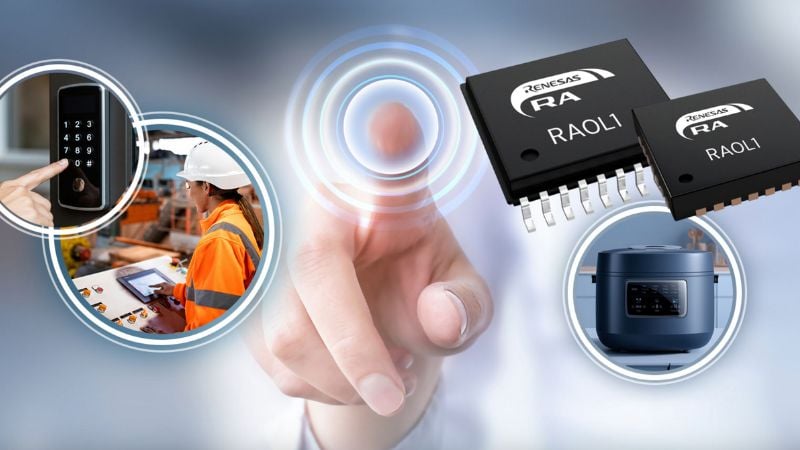
The RA0L1 targets cost-sensitive applications in consumer electronics, system control for small appliances, industrial system control, and building automation.
More and more smart devices require both low power and advanced human interfaces. The RA0L1 includes up to 24 capacitive touch channels and a controlled-current drive port for human interfaces, allowing it to support multi-frequency measurement and meet IEC61000 4-3 Level 4 standards. This makes it a candidate for medical devices and applications with high potential for electromagnetic interference.
A Focus on Low Power
The RA0L1 (datasheet linked) draws only 0.92 mA in sleep mode and 2.9 mA in active mode. It comes with an integrated high-speed, on-chip oscillator (HOCO) for the fastest wake-up time in this microcontroller class. The fast wake-up time allows the MCU to spend more time in software standby mode, which has an even lower power consumption than sleep. Standby draws just 0.25 µA. According to Renesas, through careful use of software standby mode, devices can reduce current consumption by up to 90% over competitive solutions.
Varied Features With High Compatibility
The RA0L1 fits in the lowest-power category of the RA family of microcontrollers. RA family developers can easily move up and down the line with the family's model-to-model consistency. The part’s wide 1.6 V to 5.5 V operating range creates compatibility with a broad spectrum of external components without always needing voltage level shifting circuitry.
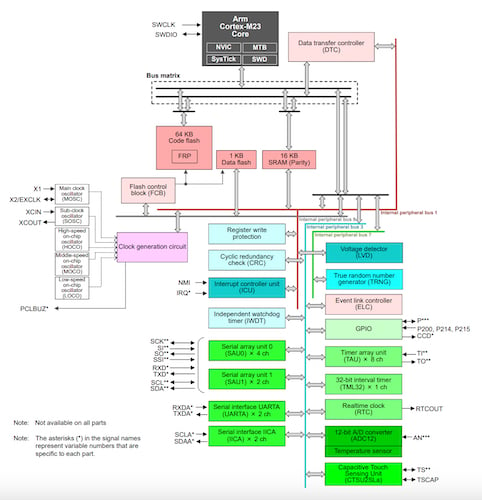
Block diagram of the RA0L1 (page 5 of the datasheet).
For memory, the device offers up to 64 KB of code flash, 1 KB of data flash (with a one-million write/erase lifespan), and 16 KB of SRAM. It supports communication protocols including three UARTs, two Async UARTs, six simplified SPIs, two I2Cs, and six simplified I2Cs. It also includes up to 44 GPIOs depending on the package. Analog features include a 12-bit ADC, a temperature sensor, and an internal reference voltage. Users will also find five internal clock modes up to 32 MHz, including a HOCO, 16x8 timer array, 32-bit internal timer, and real-time clock (RTC).
Renesas increased both security and safety features in the RA0L1, integrating a 128-bit unique ID, a true random number generator (TRNG), and flash read protection. SRAM parity check, invalid memory access detection, frequency detection, A/D test, output level detection, CRC calculator, and register write protection also bolster its protection.
The part comes in a number of small form-factor packages, with the smallest being a 24-pin 4 mm x 4 mm HWQFN, and the largest being a 48-pin 7 mm x 7mm LFQFP. All variants operate within a temperature range of either -40℃ to +105℃ or -40℃ to +125℃
Software and Support
The RA0L1 microcontrollers can be programmed with Renesas' flexible software package (FSP). FSP is an integrated development environment that includes support for multiple real-time OSes (RTOSes), a custom board support package (BSP) creator, peripheral drivers, middleware, connectivity, and other stacks. It also includes reference builds for AI motor control and cloud-based edge applications.
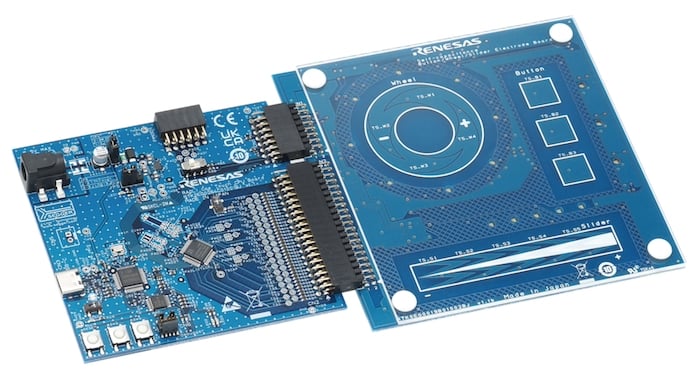
RSSK-RA0L1 capacitive touch evaluation system.
Two evaluation boards are offered for firmware development. The RSSK-RA0L1 comes with a capacitive touch board, enabling immediate evaluation of the touch interface features. The FPB-RA0L1 is a more generic evaluation board that comes equipped with Arduino hardware interface headers and two PMOD interface headers.
All images used courtesy of Renesas.
Related Content