Facebook
 Google
 GitHub
 Linkedin
Band-Pass Filters
In Figure 15-16, we have a Sallen & Key band-pass filter. We get this filter by taking the second-order low-pass filter from the Low-Pass Filters page and converting one RC network to high-pass.
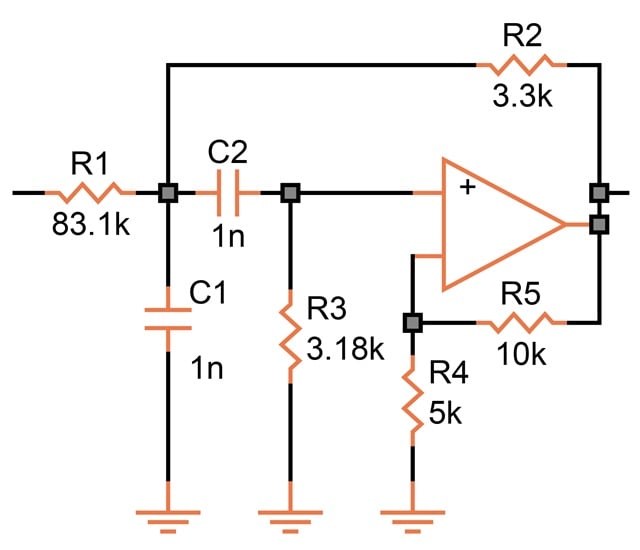
Figure 15-16. Sallen & Key band-pass filter.
As Figure 15-17 shows, we now have a drop-off in amplitude at both high and low frequencies.
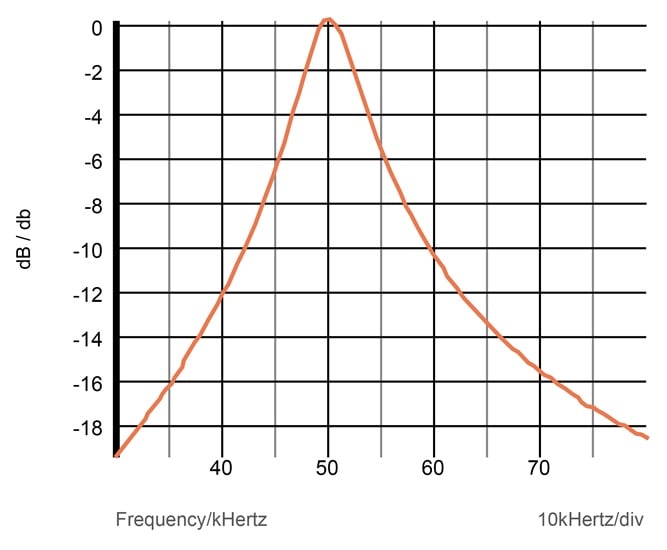
Figure 15-17. Second-order band-pass filter response.
Although the arrangement is called a second-order band-pass filter, the drop-off rate is only first-order (20 dB per decade) since only one pole is active in each frequency segment. We can, of course, improve this by adding more stages. Each stage contributes another 20 dB per decade drop-off.
There are a bewildering number of band-pass schemes available, including Wien-Robinson, Deliyannis, Fliege, Twin-T, Mikhael-Bhattacharyya, Berka-Herpy and Akerberg-Mossberg. Your filter program will tell you which one to choose.
An Alternate Band-Pass Filter Response
The elliptic (or Cauer) frequency response provides an even steeper initial drop-off around the passband than the Chebyshev. However, the attenuation outside the passband is not flat.
We can implement an elliptic band-pass filter using two Twin-T stages. This is illustrated in Figure 15-18.
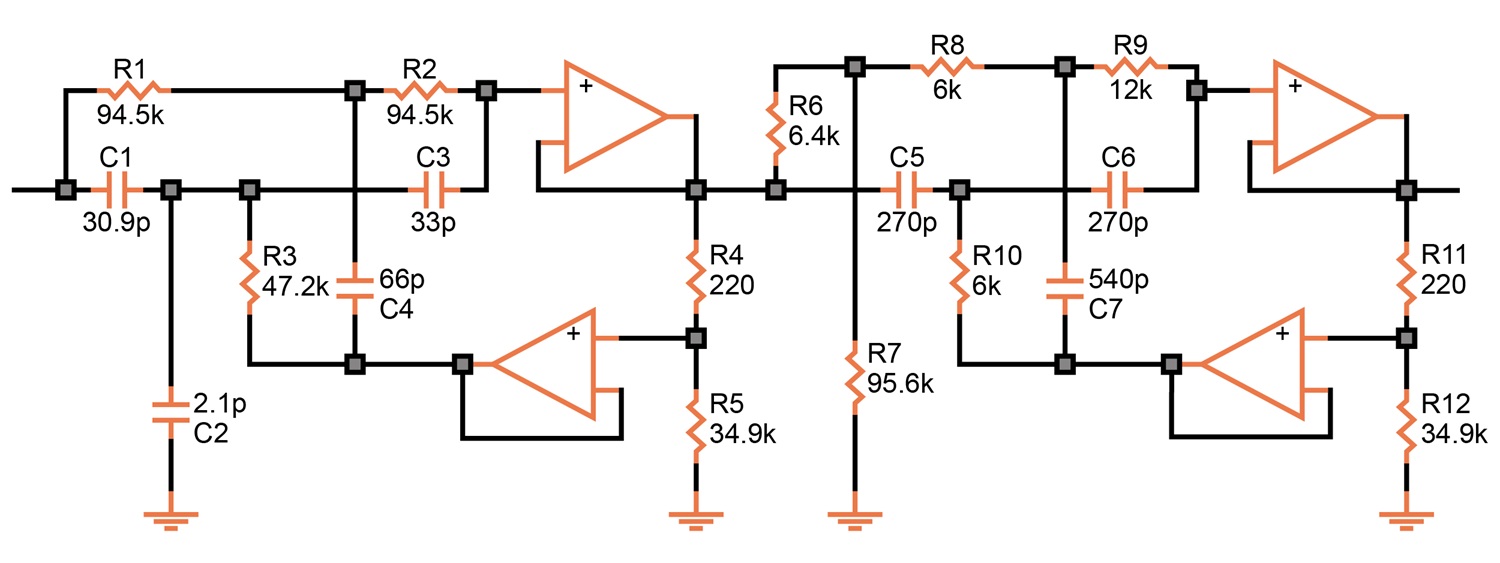
Figure 15-18. [click to enlarge] A fourth-order, Twin-T, elliptic band-pass filter.
The first stage is a second-order low-pass notch configuration. The second stage is a second-order high-pass notch filter. Figure 15-19 shows the frequency response of this filter, which has a center frequency of 50 kHz and a bandwidth of 2 kHz.
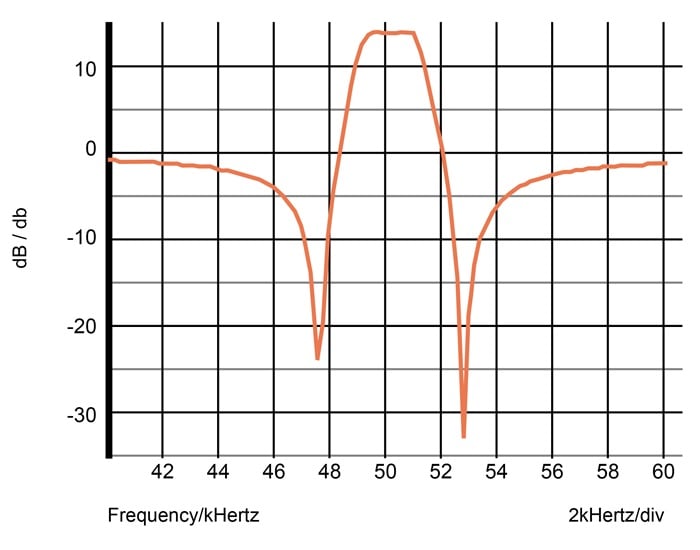
Figure 15-19. Response of a fourth-order elliptic band-pass filter.
Just outside the passband, the attenuation reaches its maximum. However, it then settles down to a modest 15 dB.
Drawbacks of Band-Pass Filters
It must be clear to you by now that active filters are costly. Not only do they require precision components, but the values of most capacitors and some of the resistors are such that they cannot be integrated. A fourth-order low-pass or high-pass filter requires at least eight external components and five pins. For a band-pass filter with only modest performance, 14 external components and pins are needed.