Facebook
 Google
 GitHub
 Linkedin
Introduction to Analog Filters
We can go back as far as 100 years and find elaborate electronic filters using inductors, capacitors, and resistors. The inductor in these circuits has always been the problem child—the largest, heaviest, most expensive, and least reliable component. With the advent of integrated circuits, its status moved from undesirable to virtually impossible.
There's an intriguing relationship between the inductor and the capacitor. They are direct opposites. As you charge an inductor, the voltage appears first and the current follows later. In a capacitor, the current must flow before the voltage can build up.
If we build a circuit that shifts the phase 180 degrees, a capacitor acts like an inductor. It is on this phenomenon that IC filters are based.
Passive Filters
Let's start by considering a simple RC network (Figure 15-1).
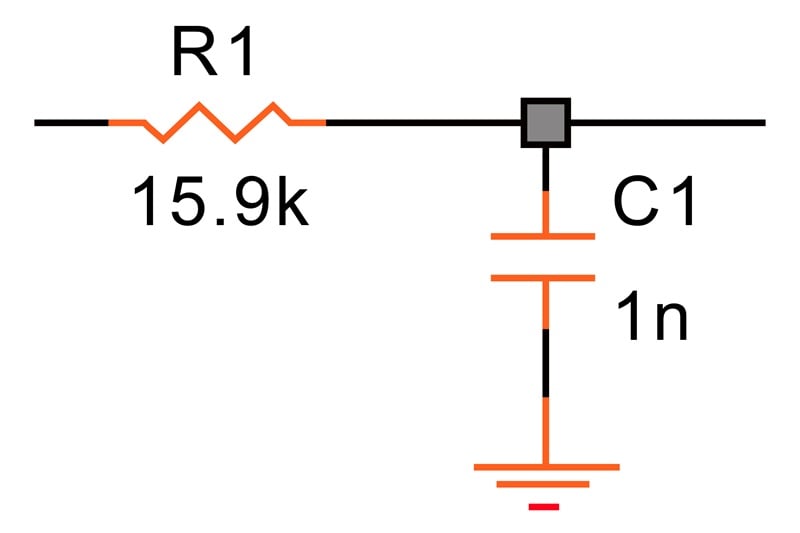
Figure 15-1. Single-pole RC low-pass filter.
This filter has a cutoff frequency (the point at which the amplitude drops by 3 dB) of:
$$f_{3dB} ~=~ \frac {1}{2\pi RC}$$
For the values shown in Figure 15-1, the cutoff frequency is 10 kHz. We can confirm this by examining Figure 15-2, which shows the filter's frequency response. If you extend the straight portion of the curve in Figure 15-2 upward, it points precisely to 10 kHz.
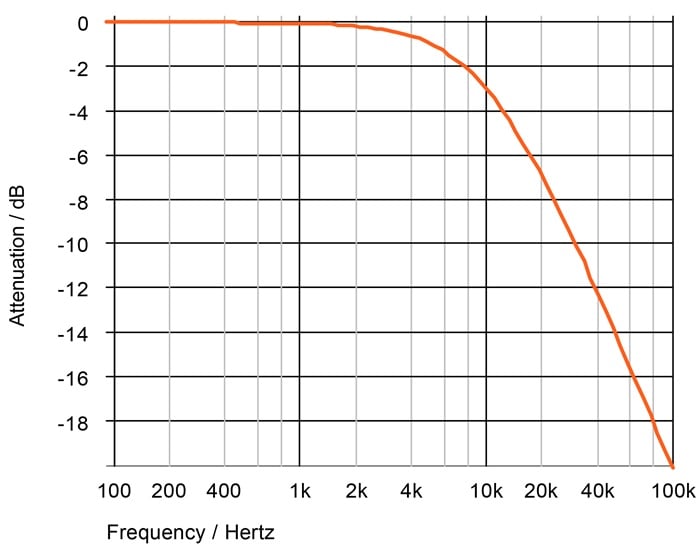
 Figure 15-2. Frequency response of a single-pole filter.
Below about 1 kHz, there is no attenuation. At 10 kHz, the signal at the output is down by 3 dB. At 100 kHz (10 times f3dB), the attenuation is 20 dB.
Such a single-pole, passive filter is said to have an attenuation of 20 dB per decade or 6 dB per octave. An octave represents a doubling of the frequency.
Cascaded Filters
We don't need to be satisfied with just one RC network. Instead, we can connect several of them in series (i.e., cascade them). As illustrated in Figure 15-3, however, we need to put a buffer in between the stages. Otherwise, each succeeding network will load down the previous one too much.
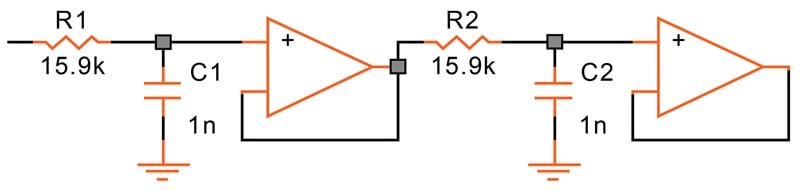
Figure 15-3. A two-stage cascade low-pass filter.
However, this is a poor way to sharpen the filter response. The second stage will roll off faster, but it also lowers the 3 dB frequency. This can be seen in Figure 15-4.
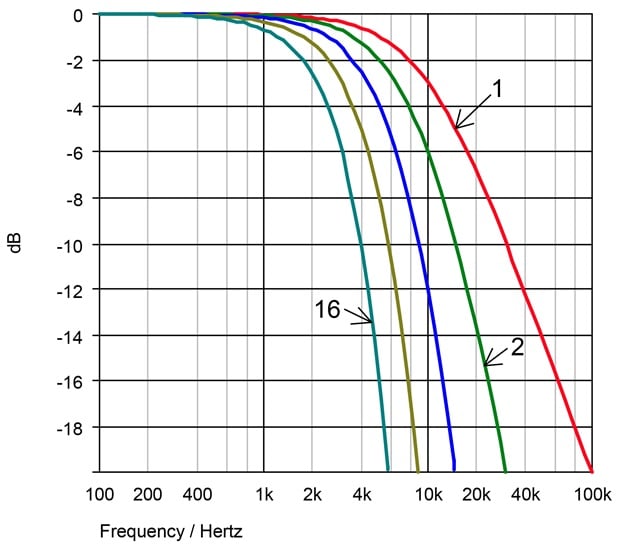
 Figure 15-4. Placing identical low-pass stages in series lowers the cutoff frequency.
The more stages there are in series, the lower the cutoff frequency. With 16 stages, it has moved down to a little over 2 kHz.
Improving Filter Design
We can do much better than this on two fronts. First, the frequency response can be shaped at will by choosing different resistor and capacitor values for each stage. Methods for improving the frequency response were worked out mathematically a long time ago, in the era of passive filters. Some of these—the Bessel, Chebyshev, and Butterworth filters, for example—are still known today by the names of their creators.
Second, we can take advantage of active components such as op amps and create more compact filter stages. We'll discuss this further in the rest of this chapter.
Bessel, Chebyshev, and Butterworth
Friedrich Wilhelm Bessel (1784 to 1846) was a professor of astronomy at the University of Königsberg in Germany. By measuring the positions of some 50,000 stars, he greatly advanced the state of celestial mechanics. In the process, he came up with the Bessel function, which was found to also be useful in filters.Pafnuty Chebyshev (1821 to 1894) taught mathematics at the University of St. Petersburg. His major contribution was the theory of prime numbers. Similar to Bessel, though, he left behind a function that later turned out to be applicable to filters.
Of Stephen Butterworth (1885 to 1958), we know only that he worked at the British Admiralty for almost all his life. In 1930, he published a paper, "On the Theory of Filters."