Facebook
 Google
 GitHub
 Linkedin
Lateral PNP Transistors
The emitter of a lateral PNP transistor (Figure 19-9) is the dark contact in the center of a P-type (NPN base) diffusion. It is surrounded by the collector, another P-type region.
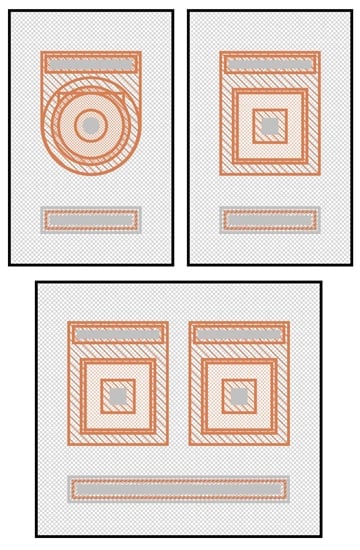
Figure 19-9. Lateral PNP transistors.
The distance between the outer edge of the emitter and the inner edge of the collector is the base width. Since the emitter and collector are on the same mask, they are inherently self-aligned, so the base width tends to be very accurate. The base width needs to be large enough to accommodate the two sideways diffusions and the depletion region spreading from the collector toward the emitter.
By extending the emitter metal so that it covers the entire base, a field plate is created. It is always connected to the emitter, which has the highest positive voltage.
The field plate improves the gain of the transistor at low current by keeping P-type charges away from the surface. In a CMOS process, the poly layer is used as a field plate when creating bipolar transistors.
The transistor shown in the top left of Figure 19-9 has a circular emitter. Although this results in a uniform base width and thus theoretically produces the highest possible gain, there is actually very little enhancement over the simpler square one at the top right.
A third terminal can be seen at the bottom of the transistor. This is the base contact. It is identical to a collector contact for an NPN transistor.
For a lateral PNP transistor in a bipolar process, the presence of a buried layer is essential. Without it, the substrate—which is connected to the most negative supply—would be just as attractive a collector as the intended one. About half the emitter current would flow to the collector, the other half to the substrate.
The dual pattern at the bottom of Figure 19-9 should be avoided. It looks attractive, especially since lateral PNP transistors often have common bases (in current mirrors, for example). However, the two devices influence each other, especially in saturation.