Facebook
 Google
 GitHub
 Linkedin
LC Oscillators
Except at frequencies above 1 GHz, inductors are rarely used in integrated circuit oscillators. However, there are occasions at lower frequencies when only an inductor can give you the performance required.
In LC oscillators, the parallel connection of an inductor (L) and capacitor (C) define the oscillation frequency. An example of an LC circuit is shown in Figure 13-21. It's designed to create a 10 MHz sine wave with a large amplitude.
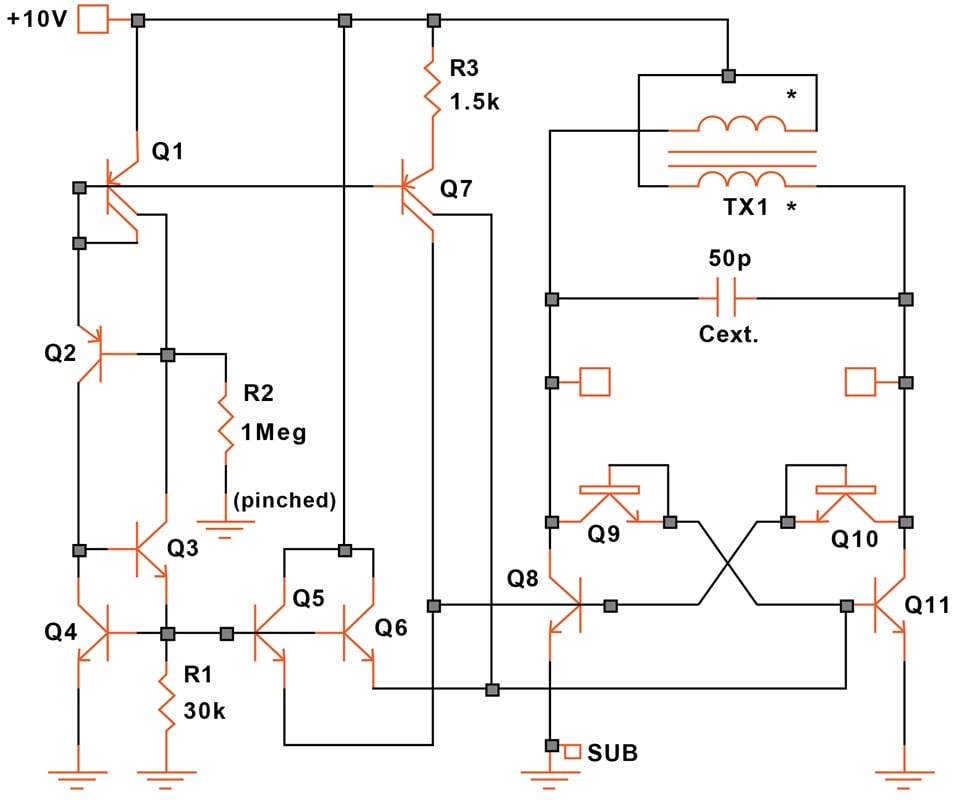
Figure 13-21. Sine-wave oscillator with large amplitude. [click to enlarge]
In the above design, Q8 and Q11 are the oscillating transistors. They are cross-coupled by the collector-base capacitances of Q9 and Q10 (about 8 pF each). A small current (about 12 μA) is injected into the bases of Q8 and Q11 to bring them to a current level at which there’s sufficient gain.
Figure 13-22 shows the simulated voltage swing for this oscillator. Note that TX1 is shown as a transformer with two windings for the purposes of the simulation. In reality, it’s a center-tapped transformer.
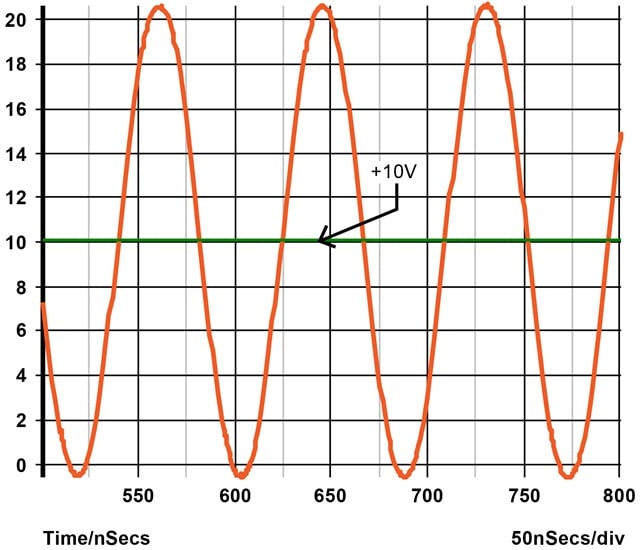
Figure 13-22. The voltage swing of the oscillator extends to twice the supply voltage.
The collectors of the oscillating transistors start at the supply voltage (10 V). After a few hundred cycles of gradually increasing amplitude, the waveform at each collector is limited by the emitters of Q5 and Q6 at the negative end. At this point, the peak-to-peak amplitude has reached 21 V—more than twice the supply voltage.
The action of the center-tapped inductor is that of a seesaw. One end dips to ground (or slightly below) while the other peaks at a little above 20 V.
Though the supply voltage is 10 V, the four transistors Q8 to Q11 must have a voltage capability of 21 V. To minimize the output capacitance, each oscillating transistor can share a collector region with its cross-coupling capacitor.