Facebook
 Google
 GitHub
 Linkedin
Basic Electricity
Arc Flash and Arc Blast
10 questions By Tony R. Kuphaldt
-
Question 4 of 10
How hot can the temperature of an arc flash become?
Reveal answerUpwards of 20,000 degrees Kelvin (I’ll leave it to you to convert this into degrees Celsius or Fahrenheit).
Notes:Note to your students that this temperature is roughly four times that of the Sun’s surface!!! Very, very, hot an arc flash is! In fact, no materials known are able to withstand such extreme temperatures without becoming vaporized. It takes little imagination to realize what an arc flash can do to human skin.
-
Question 5 of 10
What types of electrical systems pose a substantial threat of arc flash and arc blast?
Reveal answerElectrical power systems, particularly high-voltage (480 volts and above). This is not to say that arc flash and arc blast cannot occur in systems of lesser voltage, but they are less likely to be as destructive.
Follow-up question: what types of job activities would likely bring a person into a situation where arc flash and arc blast are possible, or even likely?
Notes:Not all electrical systems harbor the danger of arc flash and arc blast, but many do. While it may be obvious to some of your students that the small-scale electrical and electronic circuits they will be building in your course pose no threat of arc flash or arc blast, it is important to reassure the others that this is a hazard almost impossible to exist in a classroom environment.
-
Question 6 of 10
A Jacob’s Ladder is a novelty device designed to produce high-voltage arcs. It consists of a source of high voltage (usually a step-up “transformer” which takes the 120 volt AC utility power voltage and increases it to several thousand volts AC) and a pair of stiff wires or metal rods with a small air gap near the bottom and a large air gap near the top:

When powered, an arc develops at the point where the two rods are closest, then travels up the length of the rods, becoming wider and wider, until it “breaks” off the top of the rods. Once the arc is extinguished, a new arc forms at the bottom of the rods again.
Explain why the arc begins at the point where the rods are closest together. Also, explain why the arc then moves upward along the rods’ length, rather than remaining at the bottom where the gap is shorter.
Reveal answerThe arc begins at the shortest gap because that is where the electric field strength (volts per inch) is greatest. Once the air ionizes, its resistance decreases dramatically, and the voltage between the two rods likewise decreases due to the “loading” effect of the arc.
Challenge question: how do the principles behind the operation of a “Jacob’s Ladder” relate to arc flash and arc blast in high-current electrical faults?
Notes:Discuss with your students the nature of gas ionization, and why it occurs at the shortest gap first. Also discuss why the transformer’s output voltage decreases once the arc forms. This has nothing to do with the transformer in particular as a power source, but would tend to happen with any high-voltage power source due to internal resistance.
One method of documenting the arc process in detail is to draw a graph of voltage between the rods over time:
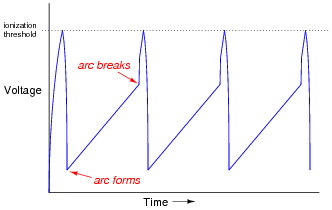
The most important point of this question, though, is to relate these principles to the topic of ärc blast”. How does the dramatic decrease in air resistance (after ionization) relate to the magnitude of arc current? How does the motion of the arc in a Jacob’s Ladder relate to the high temperatures of an arc? What about the difference in gaps between the bottom of the rods versus the top - how does this relate to the physical size of arcs in an electrical power system fault?