
 Facebook
 Google
 GitHub
 Linkedin
Basic Electricity
Batteries
14 questions By Tony R. Kuphaldt
-
Question 7 of 14
Suppose I desired to power the light bulbs in a remote cabin with solar power, charging a large battery bank. The battery bank needs to be able to power ten 60-watt light bulbs for eight hours without being recharged. The system voltage is 115 volts. How large must the battery bank be, in total amp-hours?
Reveal answerAt least 41.7 amp-hours of capacity is needed, at 115 volts.
Notes:Ask your students what they would recommend for a battery bank capacity if they were designing this system. Would they specify 41.7 amp-hours exactly? Why or why not?
-
Question 8 of 14
Suppose a 12 volt lead-acid battery has an internal resistance of 20 milli-ohms (20 mΩ):

If a short-circuit were placed across the terminals of this large battery, the fault current would be quite large: 600 amps!
Now suppose three of these batteries were connected directly in parallel with one another:
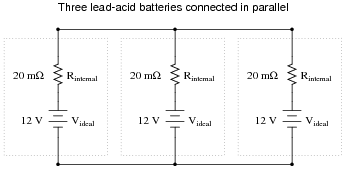
Reduce this network of parallel-connected batteries into either a Thévenin or a Norton equivalent circuit, and then re-calculate the fault current available at the terminals of the three-battery “bank” in the event of a direct short-circuit.
Reveal answerIfault = 1800 amps
Follow-up question: explain what practical importance this question has for parallel-connected batteries, and how either Thévenin’s or Norton’s theorems makes the concept easier to explain to someone else. What safety issues might be raised by the parallel connection of large batteries such as these?
Notes:Ask your students whether they used Thévenin’s Theorem or Norton’s theorem to solve for the fault current. Have students demonstrate the analysis both ways to see which is easiest to understand.
-
Question 9 of 14
This heavy-duty battery test circuit seems to have a problem. Instead of the voltmeter drooping when the test switch is closed, it remains steady regardless of switch state. This happens even when the battery under test is known to be weak:

Other clues to the problem include the fact that rheostat setting seems to make no difference in the voltmeter’s indication, and also that the cooling fan motor does not come on when the switch is pressed.
Identify possible faults in this circuit that could account for the symptoms listed here. Also, explain why each of your proposed faults would cause the observed symptoms.
Reveal answerPossible faults include broken wires or open connections at the following points in the circuit (marked with “X”):

Note: there is one more fault possibility that I have not listed here!
Notes:Discuss this simple circuit with your students, asking them how they diagnosed the problem and what possible faults could account for it. Encourage them to explore more than one possibility in their diagnoses!
In case a student happens to ask what the cooling fan is there for, tell them that it is there to provide cooling to the rheostat when in use.






sometimes battery with small capacity (Ah) has a high Cranking Amperes (CA). for example Motorcycle battery 4 Ah has 140 CA. Automotive battery 35 Ah has 350 CA. 35 Ah is more than 8 times of 4 Ah but the CA just only 350 CA