
 Facebook
 Google
 GitHub
 Linkedin
Basic Electricity
Safety Grounding
12 questions By Tony R. Kuphaldt
-
Question 7 of 12
The presence of a “ground” wire increases the degree of electrical safety for anyone using an electrical appliance. It entails having a third “prong” on the power plug, connecting with a third hole on the power receptacle, which connects to a separate wire running all the way back to the power system’s grounding point:
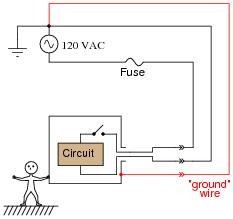
But why not eliminate all that extra wiring, and simply connect the third hole on the power receptacle to the “neutral” wire?
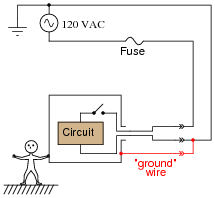
Why would this idea be unwise?
Reveal answerUsing the neutral conductor as a safety ground is a bad idea, in the event the neutral wire were to ever fail “open” between the receptacle and the system ground point.
Notes:Discuss this particular failure scenario with your students, drawing a schematic diagram if necessary. Not only does this illustrate the importance of having a separate ground conductor, but it also shows how the neutral wire can potentially be unsafe to touch!
-
Question 8 of 12
In the United States of America, the National Electrical Code (NEC) specifies certain color codes to be used for designation of grounded, grounding, and ungrounded wires in AC power systems. First, relate the terms “hot,” “neutral,” and “ground” to the terms “grounded,” “grounding,” and “ungrounded”. Then, describe the acceptable color codes for each conductor. Also, note the article and section of the National Electrical Code under which these specifications are found.
Reveal answerGrounded = White or natural grey.
Grounding = Bare (uninsulated), green, or green with a yellow stripe.
Ungrounded = Colors other than white, natural grey, or green.
Notes:It is important to note that even though these color codes have been standardized for many years, it is unwise to rely on color coding as an indication of hazard. In other words, just because a wire has green insulation does not mean it is necessarily safe to touch! There will always be mistakes made from time to time in wire installation, and in older systems where someone might have re-connected wires in incorrect ways. When in doubt, always use a voltmeter to check for the presence of hazardous voltage!
-
Question 9 of 12
Explain how you would use a voltmeter to identify the “hot,” “neutral,” and “ground” conductors on a three-prong power receptacle:

Reveal answerI’ll give you this hint: no more than two voltage measurements are necessary to identify all three jacks in a properly connected three-prong power receptacle!
Notes:Knowing how to check for proper wiring in power receptacles is a very practical skill for homeowners. Sure, there are simple neon-lamp testers available that you can simply plug in to a receptacle to test it, but using a voltmeter requires knowledge.
Incidentally, this test is very easy to perform during class discussion time, as multiple power receptacles should be available in any classroom. Be sure to review certain basic safety rules (use one hand only, etc.) when performing this test!






For question 9, how are you supposed to distinguish between ground and neutral using a voltmeter? Is there an assumption that the bottom conductor is ground?