Facebook
 Google
 GitHub
 Linkedin
Analog Integrated Circuits
Servo Motor Systems
9 questions By Tony R. Kuphaldt
-
Question 4 of 9
When the switch closes, the ammeter will initially register a large amount of current, then the current will decay to a much lesser value over time as the motor speeds up:
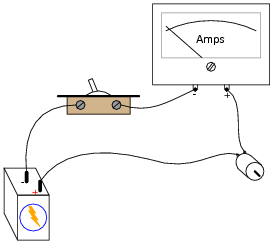
In view of Ohm’s Law, where current is supposed to be a direct function of voltage and resistance (I = E/R), explain why this happens. After all, the motor’s winding resistance does not change as it spins, and the battery voltage is fairly constant. Why, then, does the current vary so greatly between initial start-up and full operating speed?
What do you think the ammeter will register after the motor has achieved full (no-load) speed, if a mechanical load is placed on the motor shaft, forcing it to slow down?
Reveal answerMotor current is inversely proportional to speed, due to the counter-EMF produced by the armature as it rotates.
Follow-up question: draw a schematic diagram showing the equivalent circuit of battery, switch, ammeter, and motor, with the counter-EMF of the motor represented as another battery symbol. Which way must the counter-EMF voltage face, opposed to the battery voltage, or aiding the battery voltage?
Notes:The so-called “inrush” current of an electric motor during startup can be quite substantial, upwards of ten times the normal full-load current!
-
Question 5 of 9
A DC electric motor spinning at 4500 RPM draws 3 amps of current with 110 volts measured at its terminals. The resistance of the armature windings, measured with an ohmmeter when the motor is at rest, unpowered, is 2.45 ohms. How much counter-EMF is the motor generating at 4500 RPM?
How much “inrush” current will there be when the motor is initially powered up (armature speed = 0 RPM), once again assuming 110 volts at the terminals?
Reveal answerEcounter = 102.65 V @ 4500 RPM
Iinrush = 44.9 A
Notes:This calculation helps students realize just how significant the “inrush” current of an electric motor is.
-
Question 6 of 9
Explain what a servo motor system is, in your own words.
Reveal answerA servo motor is one whose position is controlled by a negative feedback system. I know, this definition is very minimal, but then I want you to express the answer in your own words!
Notes:Servos come in many different types and sizes, but they all share similar characteristics. Your students should have no problem at all finding information on them.