Facebook
 Google
 GitHub
 Linkedin
Analog Integrated Circuits
Servo Motor Systems
9 questions By Tony R. Kuphaldt
-
Question 7 of 9
A common type of rotary encoder is one built to produce a quadrature output:
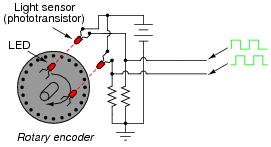
The two LED/phototransistor pairs are arranged in such a way that their pulse outputs are always 90o out of phase with each other. Quadrature output encoders are useful because they allow us to determine direction of motion as well as incremental position.
Building a quadrature direction detector circuit is easy, if you use a D-type flip-flop:
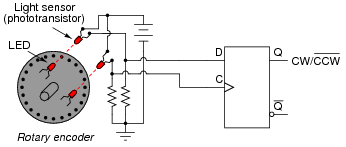
Analyze this circuit, and explain how it works.
Reveal answerThe operation of this circuit is quite easy to understand if you draw a pulse diagram for it and analyze the flip-flop’s output over time. When the encoder disk spins clockwise, the Q output goes high; when counterclockwise, the Q goes low.
Follow-up question: comment on the notation used for this circuit’s output. What does the label “\(CW/\overline{CCW}\)” tell you, without having to analyze the circuit at all?
Notes:Quadrature direction-detection circuits such as this become important when encoders are linked to digital counter circuits. The complemented notation is also very common in counter circuits.
Students may show a reluctance to draw a timing diagram when they approach this problem, even when they realize the utility of such a diagram. Instead, many will try to figure the circuit out just by looking at it. Note the emphasis on the word “try.” This circuit is much more difficult to figure out without a timing diagram! Withhold your explanation of this circuit until each student shows you a timing diagram for it. Emphasize the fact that this step, although it consumes a bit of time, is actually a time-saver in the end.
-
Question 8 of 9
Radio-controlled toy cars, airplanes, and boats use small servo motors for positioning of the steering mechanisms, engine throttle position, and such. These servos have the motor, position sensor, and control electronics housed in the same plastic package, making them very compact.
Research the type(s) of control signals used to command these servo units. In other words, find out what sort of electronic signal they require to “command” them to go to certain positions. Then, suggest a circuit that could generate these signals.
Reveal answerI will not give an answer here, not just because I want you to do all the research and thinking for yourself, but also because RC servo technology may have changed changed since I wrote this question!
Notes:The availability of inexpensive RC servos makes them ideal for use in lab experiments and student projects. It is well worth your students’ time (and yours!) to find out how these amazing little devices are controlled!
-
Question 9 of 9
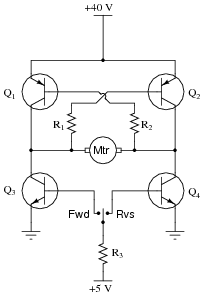
Determine all component voltage drops in this circuit when the motor is operating in the reverse direction. Be sure to explain how you performed all the analyses! Assume 0.7 volts as the standard forward voltage drop for a forward-biased PN junction, and 0.3 volts as the standard collector-to-emitter voltage drop for a saturated BJT.
Reveal answerI’ll give you a hint: use Kirchhoff’s Voltage Law.
Challenge question: what type of DC motor must this be, to be reversed in rotational direction by a reversal of polarity?
Notes:The primary purpose of this question is to give students more practice using Kirchhoff’s Voltage Law. Be sure to work through the analysis of all component voltage drops.