Facebook
 Google
 GitHub
 Linkedin
Sum and Product Notation
For reference, this section introduces the terminology used in some texts to describe the minterms and maxterms assigned to a Karnaugh map. Otherwise, there is no new material here.
Terminology for Minterms
Σ (sigma) indicates sum and lower case “m” indicates minterms. Σm indicates sum of minterms. The following example is revisited to illustrate our point. Instead of a Boolean equation description of unsimplified logic, we list the minterms.
f(A,B,C,D) = Σ m(1, 2, 3, 4, 5, 7, 8, 9, 11, 12, 13, 15)
or
f(A,B,C,D) = Σ(m1,m2,m3,m4,m5,m7,m8,m9,m11,m12,m13,m15)
The numbers indicate cell location, or address, within a Karnaugh map as shown below right. This is certainly a compact means of describing a list of minterms or cells in a K-map.
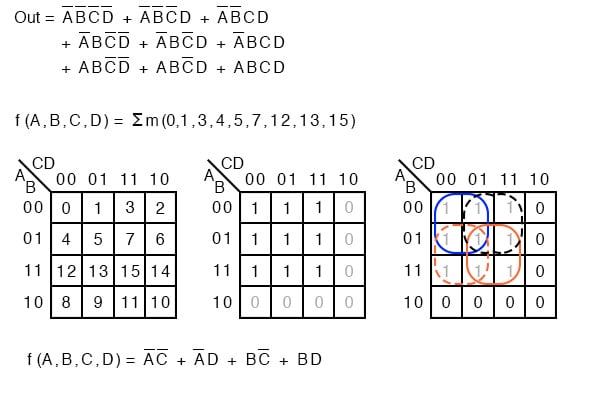
The Sum-Of-Products solution is not affected by the new terminology. The minterms, 1s, in the map have been grouped as usual and a Sum-OF-Products solution written.
Terminology for Maxterms
Below, we show the terminology for describing a list of maxterms. Product is indicated by the Greek Π (pi), and upper case “M” indicates maxterms. ΠM indicates product of maxterms. The same example illustrates our point.
The Boolean equation description of unsimplified logic, is replaced by a list of maxterms.
f(A,B,C,D) = Π M(2, 6, 8, 9, 10, 11, 14)
or
f(A,B,C,D) = Π(M2, M6, M8, M9, M10, M11, M14)
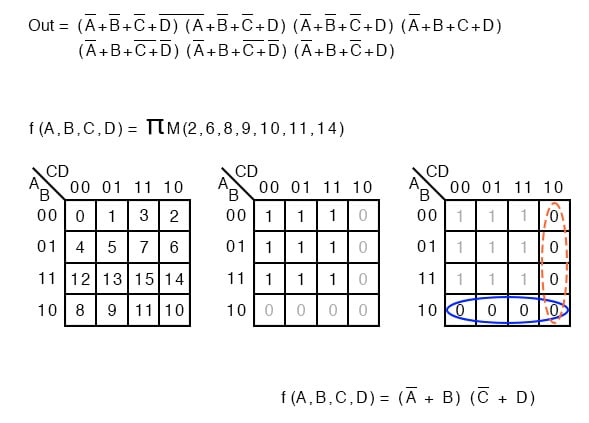
Once again, the numbers indicate K-map cell address locations. For maxterms this is the location of 0s, as shown below. A Product-OF-Sums solution is completed in the usual manner.
$$Out = (A + B + \bar{C} + D)(A + \bar{B} + \bar{C} + D) + (\bar{A} + B + C + \bar{D}) + (\bar{A} + B + \bar{C} + D)$$
$$(\bar{A} + B + \bar{C} +\bar{D})(\bar{A} + \bar{B} + \bar{C} + D)$$
RELATED WORKSHEETS:
- Sum-of-Products and Product-of-Sums Expressions Worksheet
- Karnaugh Mapping Worksheet
- Boolean Algebra Worksheet