
 Facebook
 Google
 GitHub
 Linkedin
Analog Integrated Circuits
AC Negative Feedback OpAmp Circuits
14 questions By Tony R. Kuphaldt
-
Question 10 of 14
Explain the effect that compensation capacitance has on an operational amplifier’s gain-bandwidth product (GBW). Does a larger compensation capacitance yield a greater GBW or a lesser GBW, and why?
Reveal answerThe greater the amount of compensation capacitance in an op-amp (either internal, or externally connected), the less the GBW product.
Notes:In this question, the really important aspect is not the answer given. What is important here is that students understand what GBW product is, and how it is affected by this thing we call “compensation capacitance” (another topic of research). The goal here is to get students to research these concepts and relate them together, so please do not be satisfied with any student answers that merely restate the answer given here! Ask students to explain what these terms and concepts mean, and to explain why the GBW product decreases with increased Ccomp.
-
Question 11 of 14
An important AC performance parameter for operational amplifiers is slew rate. Explain what “slew rate” is, and what causes it to be less than optimal for an opamp.
Reveal answerSlew rate is the maximum rate of change of output voltage over time \(\frac{dv}{dt}\)|max that an opamp can muster.
Follow-up question: what would the output waveform of an opamp look like if it were trying to amplify a square wave signal with a frequency and amplitude exceeding the amplifier’s slew rate?
Notes:The follow-up question is very important, as it asks students to apply the concept of a maximum [dv/dt] to actual waveshapes. This is often discussed by introductory textbooks, though, so it should not be difficult for students to find good information to help them formulate an answer.
-
Question 12 of 14
It strikes some students as odd that opamps would have a constant slew rate. That is, when subjected to a step-change input voltage, an opamp’s output voltage would quickly ramp linearly over time, rather than ramp in some other way (such as the inverse exponential curve seen in RC and RL pulse circuits):

Yet, this effect has a definite cause, and it is found in the design of the opamp’s internal circuitry: the voltage multiplication stages within operational amplifier circuits often use active loading for increased voltage gain. An example of active loading may be seen in the following schematic diagram for the classic 741 opamp, where transistor Q9 acts as an active load for transistor Q10, and where transistor Q13 provides an active load for transistor Q17:
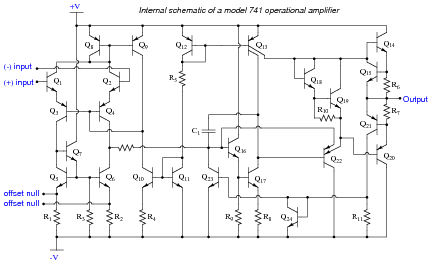
Explain how active loading creates the constant slew rate exhibited by operational amplifier circuits such as the 741. What factors account for the linear ramping of voltage over time?
Reveal answerActive loads act as constant-current sources feeding a constant (maximum) current through any capacitances in their way. This leads to constant [dv/dt] rates according to the “Ohm’s Law” equation for capacitors:
i = C dv dtFollow-up question: based on what you see here, determine what parameters could be changed within the internal circuitry of an operational amplifier to increase the slew rate.
Notes:This question provides good review of fundamental capacitor behavior, and also explains why opamps have slew rates as they do.
Related Tools:
- Performance-Based Assessments for AC Circuit Competencies
- Parallel DC Circuits Practice Worksheet With Answers


