
 Facebook
 Google
 GitHub
 Linkedin
Mathematics for Electronics
Algebraic Substitution for Electric Circuits
13 questions By Tony R. Kuphaldt
-
Question 4 of 13
Substitution is a technique whereby we let a variable represent (stand in the place of) another variable or an expression made of other variables. One application where we might use substitution is when we must manipulate an algebraic expression containing a lot of similar-looking variables, as is often the case with science problems.
Take this series-parallel resistor circuit for example:
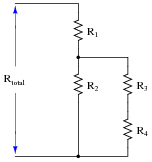
The equation expressing total resistance as a function of the four resistor values looks like this:
$$R_{total} = R_1 + \frac{R_2 (R_3 + R_4)}{R_2 + R_3 +R_4}$$
Now imagine being asked to manipulate this equation to solve for R3. When the only visual feature distinguishing each of the variables is the subscript (total, 1, 2, 3, or 4), it becomes very easy to lose track of where one is in the algebraic manipulation. A very common mistake is to exchange or needlessly repeat subscripts during the process, effectively mis-placing one or more variables. To help avoid such mistakes, you may substitute different letter variables for Rtotal, R1, R2, R3, and R4 like this:
Substitution table
Original variable New variable
Rtotal y
R1 a
R2 b
R3 c
R4 d
$$y = a + \frac{b(c+d)}{b + c + d}$$
After doing the algebraic manipulation to solve for c (R3), the equation looks like this:
$$c = \frac{(y-a)(b+d)-bd}{a+b-y}$$
Back-substitute the original R variables in place of a, b, c, d, and y as you see them in the above equation to arrive at a form that directly relates to the schematic diagram.
Reveal answer$$R_3 = \frac{(R_{total}-R_1)(R_2 + R_4)-R_2R_4}{R_1+R_2-R_{total}}$$
Challenge question: show all the steps you would take to solve for R3 in the original equation.
Notes:Here I show an application of substitution that is useful only because the human brain has difficulty distinguishing similar-looking symbols. More powerful uses of algebraic substitution exist, of course, but this is a start for students who have never seen the concept before.
-
Question 5 of 13
Substitution is a technique whereby we let a variable represent (stand in the place of) another variable or an expression made of other variables. One application where we might use substitution is when we must manipulate an algebraic expression containing multiple instances of the same sub-expression. For example, suppose we needed to manipulate this equation to solve for c:
$$1 = \frac {a+b(d^2-f^2)+c}{d^2-f^2}$$
The sub-expression d2 − f2 appears twice in this equation. Wouldn’t it be nice if we had something simpler to put in its place during the time we were busy manipulating the equation, if for no other reason than to have less variables to write on our paper while showing all the steps to our work? Well, we can do this!
Substitute the variable x for the sub-expression d2 − f2, and then solve for c. When you are done manipulating the equation, back-substitute d2 − f2 in place of x.
Reveal answerOriginal equation:
$$1 = \frac {a+b(d^2-f^2)+c}{d^2-f^2}$$
After substituting x:
$$1 = \frac {a+bx+c}{x}$$
After manipulating the equation to solve for c:
$$c = x(1-b)-a$$
Back-substituting the original sub-expression in place of x:
$$c = (d^2-f^2)(1-b)-a$$
Notes:Here I show an application of substitution that is useful only because the human brain has an easier time dealing with a single symbol than with a collection of different symbols. More powerful uses of algebraic substitution exist, of course, but this is a start for students who are new to the concept.
-
Question 6 of 13
Substitution is the term we give to the mathematical equivalence of one variable to one or more other variables in an expression. It is a fundamental principle used to combine two or more equations into a single equation (among other things).
For example, we know that the formula for calculating current in a simple one-resistor circuit is as follows:

We also know that the total resistance (R) of a three-resistor series circuit is as follows:
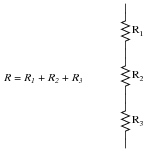
Combine these two equations together using substitution so that we have a single equation for calculating current I in a three-resistor series circuit given the source voltage V and each resistance value R1, R2, and R3:

In other words, you need to have as your answer a single equation that begins with “I = ” and has all the variables V, R1, R2, and R3 on the other side of the ëqual” sign.
Reveal answer$$1 = \frac {V}{R_1+R_2+R_3}$$
Notes:I like to speak of the process of substitution in terms of definitions for variables. In this particular case, R1 + R2 + R3 is a definition for R that we put in R’s place in the first equation (I = V/R).
The notation shown in the third schematic, I = f(V, R1, R2, R3), is known as function notation. It merely means that the value of I is determined by the values of all those variables within the parentheses, rather than just one.






In a lot of question, the ‘+’ symbol is not printed. Can you please correct this as it causes confusion while trying to solve the equation?
Question 9 says “Combined these two formulae into one solving for the resistance of a copper wire sample (RT) at a specific temperature in degrees Celsius (TC)...”.
I think it should be “at a specific temperature in degrees Fahrenheit (TF)”.