
 Facebook
 Google
 GitHub
 Linkedin
Basic Electricity
Basic Circuit Troubleshooting
18 questions By Tony R. Kuphaldt
-
Question 13 of 18
The circuit shown here is called a “bridge rectifier,” and its purpose is to convert alternating current (from the “power-supply” unit) into direct current. Suppose you were instructed to check the continuity of the switch (SW1) mounted on the printed circuit board. What would be a fast and effective way of testing this switch’s continuity (ideally, without removing the switch from the circuit board)?
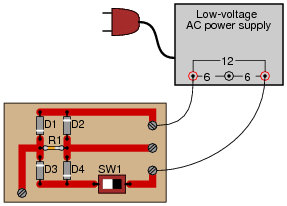
Reveal answerDisconnect the power supply from the circuit board (only one wire need be disconnected), and then use an ohmmeter to measure continuity across the switch terminals when in the ÖN” position and when in the ÖFF” position. Incidentally, this is not the only way to check the switch’s continuity, but it is the most direct.
Notes:Challenge your students to think of other methods which could be used to check the switch’s continuity. There is often more than one way to perform a certain check of component function, if you are knowledgeable in electrical theory and creative in your use of test equipment!
-
Question 14 of 18
Identify which of these are true statements:
- Between two points that are electrically common to each other, there is guaranteed to be zero voltage.
- If zero voltage is measured between two points, those points must be electrically common to each other.
- Between two points that are not electrically common to each other, there is guaranteed to be voltage.
- If voltage is measured between two points, those points must not be electrically common to each other.
Reveal answerOnly two out of the four given statements are true:
- 1. Between two points that are electrically common to each other, there is guaranteed to be zero voltage.
- 4. If voltage is measured between two points, those points must not be electrically common to each other.
For those having difficultly understanding this, test the following statements for truth. Each of these statements follows the same logical pattern of electrical statements given at the beginning of this question:
- All rabbits are mammals.
- All mammals are rabbits.
- All non-rabbits are non-mammals.
- All non-mammals are non-rabbits.
Notes:What we have here is an exercise in Aristotelian logic. In either scenario (points in a circuit, or animals), statement 2 is the converse of statement 1, while statement 3 is the inverse and statement 4 is the contrapositive. Only the contrapositive of a statement is guaranteed to share the same truth value as the original statement.
This is no esoteric exercise. Rather, it is a hard-learned fact: many students mistakenly think that because there is guaranteed to be no voltage between electrically common points in a circuit, then the absence of voltage between two points must mean those two points are electrically common to each other! This is not necessarily true, because situations exist where two points may not be electrically common, yet still have no voltage between them. Electrical commonality is just one way that two points can have zero voltage between them, not the only way!
The contrapositive of this rule, however, is a valuable troubleshooting tool: if there is substantial voltage measured between two points in a circuit, then we know without a doubt that those two points are not electrically common to each other!
-
Question 15 of 18
Suppose a technician were troubleshooting the following circuit, whose light bulb refused to light up:
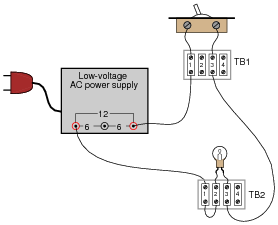
The technician records their steps on a piece of paper divided into two columns: Observations, and Conclusions, drawing a horizontal line underneath each conclusion after it is made:

Critique this technician’s troubleshooting job, noting any errors or unnecessary steps.
Reveal answerThe first step and conclusion, while seemingly unnecessary, are actually good to check. Just because someone tells you there is a problem with a circuit does not necessarily mean there is a problem with it. People can make mistakes, and it is usually a good idea to verify the nature of the problem with a system before troubleshooting.
The second conclusion (“Power supply is functioning properly”) is understated. In actuality, the presence of voltage between these two points proves that not only is the power supply functioning properly, but both wires between the power supply and terminals TB1-1 and TB2-1 have good continuity, and the connections between the wires and their respective terminals are good as well. This eliminates several portions of the circuit as being problematic.
Checking for voltage across the light bulb terminals is a good step, but the lack of voltage does not prove the light bulb is not failed! All it means is that there is some other problem between the light bulb and the last two connections where voltage was measured (between TB1-1 and TB2-1). For all we know at this point, the light bulb could be failed as well as there being a failure somewhere else in the circuit.
Checking for voltage across the switch is another good step, but the lack of voltage there does not prove that the switch has good continuity, any more than a lack of voltage proved the light bulb’s filament had good continuity either. There still could be multiple “opens” in this circuit.
The presence of voltage between TB2-1 and TB2-3 narrows the possibility of failure in the circuit quite a bit. Knowing that there is voltage between these two terminals proves there is good continuity from TB2-3 to TB1-3, through the switch, and all the way back to the power supply. From step 2 we already know there is good continuity from TB2-1 back to the power supply as well. This conclusively tells us that the problem(s) must lie between TB2-1 and TB2-3.
It is a wasted step to check for voltage between TB1-3 and TB2-1.
The measurement of voltage between TB2-1 and TB2-2 proves the location of the failure: an “open” between those two points. It also proves that there are no other “open” failures in the circuit.
The final step documenting replacement of the wire between TB2-1 and TB2-2, while not essential, is not really wasted, either. Troubleshooting journals such as this are helpful when searching for complex problems in large systems, where more than one person may have to work on finding the problem(s). If there is more than one failure in a system, it is helpful to document the repair for the benefit of anyone else working on solving the problem later!
Notes:Circuit troubleshooting is the highest level of thinking required of many electrical and electronics professionals: to identify faults efficiently based on a knowledge of fundamental principles and test equipment usage. Good troubleshooters are rare, and in my opinion that has more to do with the lack of effective technical education than it does a lack of natural ability.
It is not enough to merely tell students what they should do in troubleshooting, or to give them easy-to-follow steps. Students must be placed in scenarios where they are required to think their way through to a solution. Fortunately, electrical circuit troubleshooting is an activity that works well for small groups of students to engage in as well as individual students. A “virtual” troubleshooting exercise such as this one is a good way to start students thinking in the right ways to becoming effective troubleshooters.




May I know the people who created these examples? through APA 6 or 7 format of citation?
Some good brain teasers. It was nice getting my head wrapped around the idea of getting voltage on a common side of a circuit (due to a break on that side) 🤠