Facebook
 Google
 GitHub
 Linkedin
Basic Electricity
Elementary Circuits
12 questions By Tony R. Kuphaldt
-
Question 7 of 12
Shown here is a simplified representation of an electrical power plant and a house, with the source of electricity shown as a battery, and the only electrical “load” in the house being a single light bulb:
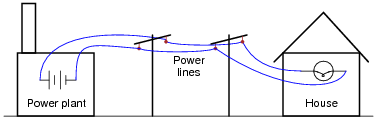
Why would anyone use two wires to conduct electricity from a power plant to a house, as shown, when they could simply use one wire and a pair of ground connections, like this?
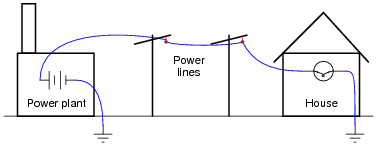
Reveal answerThis is not a practical solution, even though it would only require half the number of wires to distribute electrical power from the power plant to each house! The reason this is not practical is because the earth (dirt) is not a good enough conductor of electricity. Wires made of metal conduct electricity far more efficiently, which results in more electrical power delivered to the end user.
Notes:Discuss the fact that although the earth (dirt) is a poor conductor of electricity, it may still be able to conduct levels of current lethal to the human body! The amount of current necessary to light up a household light bulb is typically far in excess of values lethal for the human body.
-
Question 8 of 12
What, exactly, is a short circuit? What does it mean if a circuit becomes shorted? How does this differ from an open circuit?
Reveal answerA short circuit is a circuit having very little resistance, permitting large amounts of current. If a circuit becomes shorted, it means that a path for current formerly possessing substantial resistance has been bypassed by a path having negligible (almost zero) resistance.
Conversely, an open circuit is one where there is a break preventing any current from going through at all.
Notes:Discuss with your students some of the potential hazards of short circuits. It will then be apparent why a “short circuit” is a bad thing. Ask students if they can think of any realistic circumstance that could lead to a short-circuit developing.
I have noticed over several years of teaching electronics that the terms “short” or “short-circuit” are often used by new students as generic labels for any type of circuit fault, rather than the specific condition just described. This is a habit that must be corrected, if students are to communicate intelligently with others in the profession. To say that a component “is shorted” means a very definite thing: it is not a generic term for any type of circuit fault.
-
Question 9 of 12
What would have to happen in this circuit for it to become shorted? In other words, determine how to make a short circuit using the components shown here:

Reveal answer
Notes:In real life, of course, short circuits are usually things to be avoided. Discuss with your students why short circuits are generally undesirable, and what role wire insulation plays in preventing them.