
 Facebook
 Google
 GitHub
 Linkedin
Basic Electricity
Energy, Work, and Power
14 questions By Tony R. Kuphaldt
-
Question 10 of 14
What would happen if a wire having no resistance at all (0 Ω) were connected directly across the terminals of a 6-volt battery? How much power would be dissipated, according to Joule’s Law?

Suppose I short-circuited a 6-volt battery in the manner just described and found that the wire used to make the short-circuit gets warm after just a few seconds of carrying this current. Does this data agree or disagree with your predictions?
Reveal answerCalculations based on power equations would suggest either zero watts of power dissipated or infinite power dissipation, depending on which equation you chose to calculate power with. Yet, the experiment described yields a power dissipation that is neither zero nor infinite.
If you think that the wire used in the experiment is not resistance-less (i.e. it does have resistance), and that this accounts for the disparity between the predicted and measured amounts of current, you are partially correct. Realistically, a small piece of wire such as that used in the experiment will have a few tenths of an ohm of resistance. However, if you re-calculate power with a wire resistance of 0.1 Ω, you will still find a large disparity between your prediction and the actual measured power in this short-circuit.
What is going on here?
Notes:Remind students that short-circuit testing of electrical power sources can be dangerous. A student of mine once stuffed a 6-volt “lantern” battery in his tool pouch, only to have it discharge smoke an hour later, after the battery terminals had been shorted together by the metal handle of a wrench!
-
Question 11 of 14
How much electrical power is being dissipated by the light bulb in this circuit?

In this circuit, identify which component is the source and which is the load.
Reveal answer6.48 watts
Here, the battery is the source and the light bulb is the load.
Notes:The solution to this problem simply requires the application of Ohm’s Law. As for the question of source versus load, ask your students to define each of these words in terms of energy transfer.
-
Question 12 of 14
Calculate the amount of power dissipated by this electric heating element, if the generator’s output voltage is 110 volts and the heater’s resistance is 2.5 ohms:
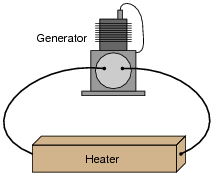
Now, calculate the power dissipated by the same heater if the generator’s output voltage is doubled.
Reveal answer4,840 watts at 110 volts; 19,360 watts at 220 volts.
Notes:Many students will mistakenly calculate 9,680 watts as the power dissipation at 220 volts. However, power dissipation does not increase linearly with increases in voltage!



Thank you so much for this reviewer