Facebook
 Google
 GitHub
 Linkedin
Embedded World North America Was Chock-Full of Innovations
Enjoy this taste of the rich collection of technology news from the Embedded World North America trade show in Austin, Texas.
We on the All About Circuits and EETech team had a fantastic and productive time at the Embedded World North America 2024 show! With a mix of scheduled meetings and impromptu drop-bys, we saw an impressive mix of embedded technologies and products. To give you a taste, in this newsletter, we’ve rounded up the highlights from a handful of the many companies that had news to share at the show.
My thanks goes out to every company and every person we interacted with, whether it was talking with us, letting us take cool pics, or just making a connection. Can’t wait until next year’s Embedded Word NA in Anaheim!
Driver Emerges From Stealth With a New Way to Write and Decode Tech Docs
At Embedded World North America, Austin-based startup Driver officially emerged from stealth mode, unveiling an AI-powered platform designed to streamline the time-consuming process of onboarding engineers and creating technical documentation. The platform, which leverages advanced large language models (LLMs), promises to significantly reduce time-to-market for product development, particularly in industries such as semiconductors, where complex codebases and extensive documentation requirements are the norm.

From left to right, All About Circuits editor-in-chief Jeff Child, Driver AI CEO Adam Tilton, and Driver AI co-founder and CTO Daniel Hensley.
Concurrent with this launch, Driver announced an $8 million seed funding round, led by Google Ventures (GV), with participation from Y Combinator and other investors.
Engineering teams, particularly in industries such as embedded systems and IoT, often face lengthy onboarding times when hiring new developers or migrating to new technologies. “When we talk to customers, we hear it takes anywhere from three to six months for an engineer to onboard onto a new piece of technology. And this doesn't just mean when they join the company,” says Driver CEO Adam Tilton (middle in image above). “Every single new project is an onboarding, and engineers constantly have to learn how to use something new.”
Driver’s platform centers around large language models that automate the decoding and documentation of complex technologies. The tool syncs directly with codebases stored in version control systems such as GitHub or other source code management (SCM) tools. Once integrated, Driver can generate comprehensive technical documentation in a fraction of the time traditionally required, reducing the process from months to hours.
Efabless Announces Custom SoC Design Platform for Edge Machine Learning
At the show, Efabless released its ChipIgnite ML custom system-on-chip (SoC) development platform. The platform targets custom chip development for remote sensor applications that require machine learning (ML) AI functionality.
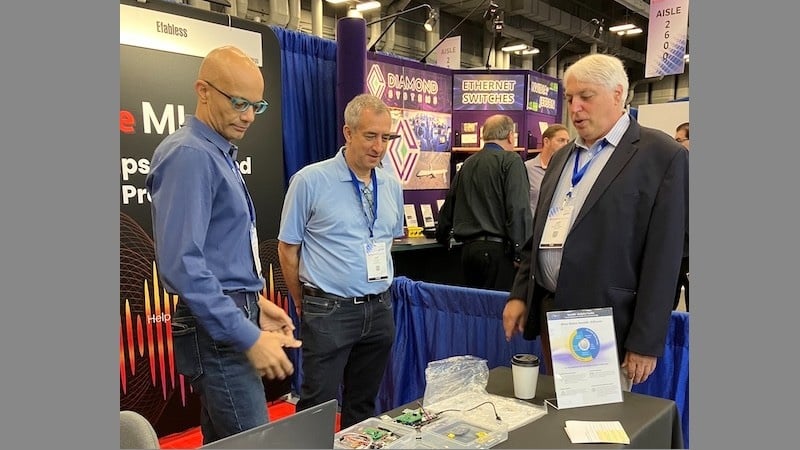
From left to right, Efabless exes Mohamed Kassem, Co-founder and CTO, Jeff DiCorpo, Senior V.P and General Manager with All About Circuits' Jeff Child at Embedded World North America.
The ChipIgnite ML platform allows edge and Internet of Things (IoT) developers to quickly design machine learning-capable silicon for remote sensor applications. The result is an application-specific integrated circuit (ASIC) that includes RISC-V processing cores and custom digital logic.
Developing a conventional IoT sensor largely requires microcontroller-based hardware along with discrete logic. Some developers add field-programmable logic to the mix. While this approach can deliver all the functionality required for remote sensor implementation, it has shortcomings when an application requires complex algorithms, AI, or ML functionality. Machine learning often requires higher-powered MCUs or watt-hungry FPGA hardware, both of which increase product size and cost and reduce battery life. In some cases, the ML processing power needed makes battery operation impractical.
The Efabless platform promotes custom chips optimized for IoT and remote sensing applications. These fully customizable chips integrate analog interfaces, hardware ML acceleration, and open-source MCU IP. The platform includes an automated design flow, allowing engineers without extensive chip-design experience to turn out highly optimized ML-capable custom ASICs.
Core features of the platform include:
- 32-bit RISC-V core
- Hard silicon IP for common ML functionality
- Modular design flow for faster time to market
- Clock-gated logic and low-power states to reduce power consumption
- Customizable analog interfaces, including programmable op-amps, ADSs, DACs
- Multi-year operability on a single coin cell battery
- Support for devices small enough to fit into a key fob-sized package
TrustInSoft Updates Analyzer Tool, Streamlining Software Verification
At Embedded World, TrustInSoft introduced significant updates to its TrustInSoft Analyzer (TISA), a tool that leverages formal methods to enhance software verification processes. The updates to the TISA software include enhanced user experience, greater precision, and improved compliance with industry standards.

TrustInSoft CEO Caroline Guillaume (left) with All About Circuits' editor-in-chief Jeff Child at the 2024 Embedded World North America in Austin, Texas.
A major upgrade to the tool is the revamped graphical user interface (GUI), which replaces the previously command-line-based project manager. The interface provides centralized access to project settings, analysis configurations, and results, streamlining team collaboration and minimizing setup errors. TrustInSoft designed the new GUI to simplify project management, enable quicker setups, and unlock the ability to track multiple software verification projects simultaneously.
Another notable addition is the TrustInSoft Root Cause Investigator, which pinpoints problems by issuing alarms and their root causes. Teams can then fine-tune analysis settings directly from the interface. The release also introduces automated driver generation based on function selection. This provides comprehensive code coverage with minimal manual configuration. The new Assisted Analysis Setup feature aids the workflow by providing step-by-step guidance that reduces the likelihood of configuration errors and offers dynamic parameter adjustments tailored to project specifics.
TISA also supports ARINC 653, automatically analyzing aerospace programs and mapping detected issues on the common weakness enumeration (CWE) database. In terms of performance, TrustInSoft claims that the new version drastically improves the speed of analyzing complex C++ codebases, with a reported 75% reduction in overall analysis time.
LDRA Adds Extended Support for RISC-V High Assurance Software Quality Tool Suite
At the event, LDRA announced extended support for the RISC-V instruction set architecture (ISA) with the company’s industry-leading high assurance quality analysis and verification tool suite.
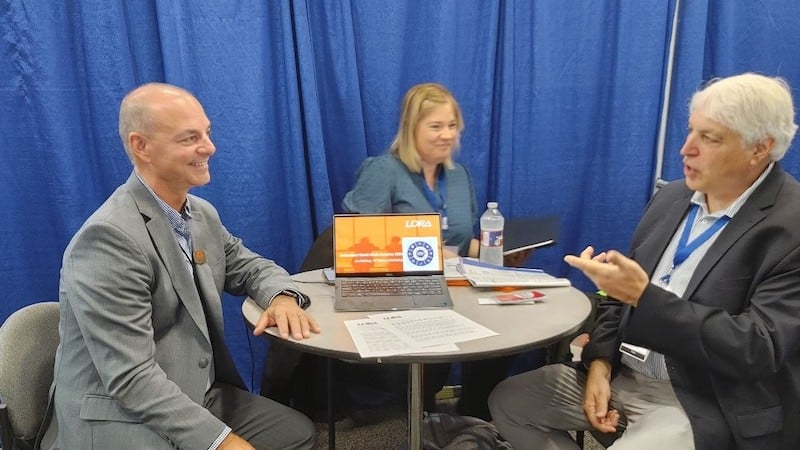
From left to right, LDRA's Jim McElroy, Kelly Wanlass, HCI Marketing and Communications, and Jeff Child
Building on its suite of Target License Packages to support emerging RISC-V implementations such as Synopsys ARC-V processor IP, LDRA says its tool suite continues to provide developers the tools they need to produce RISC-V-based critical applications for aerospace and defense, mobile, industrial, IoT, artificial intelligence and automotive that must adhere to strict functional safety and security standards.
According to the company, The RISC-V architecture is gaining momentum with developers due to its extensibility, scalability, and commercial business model. The LDRA tool suite provides development and on-target testing tools that enable a high assurance workflow for developers who must comply with functional safety and security standards. The tool suite works with commonly used compilers that support the RISC-V architecture as well as hardware tools used in on-target testing.
LDRA says it works closely with companies such as Andes Technology, Green Hills Software, Lauterbach, Synopsys, TASKING, and Wind River to offer high assurance software quality development and verification tool chain from requirements through deployment and test on processors based on the RISC-V architecture. Demonstration videos are also available with SEGGER and IAR.
The LDRA tool suite offers full support for both 32- and 64-bit instruction sets and addresses requirements traceability, coding standards compliance, and static and dynamic coverage analysis.
Pico Technology Showcases Its New MSO Models of Its PicoScope 3000E Series
At Embedded World North America, Pico Technology showcased its recently announced MSO (Mixed-Signal Oscilloscope) versions of its PicoScope 3000E Series. The latest additions combine cutting-edge technology with user-friendly design to meet the diverse needs of engineers, technicians and researchers worldwide. These new MSO models offer the same powerful features as the existing 3000E series, with added digital channel capability, making them ideal for testing and debugging mixed-signal embedded systems.
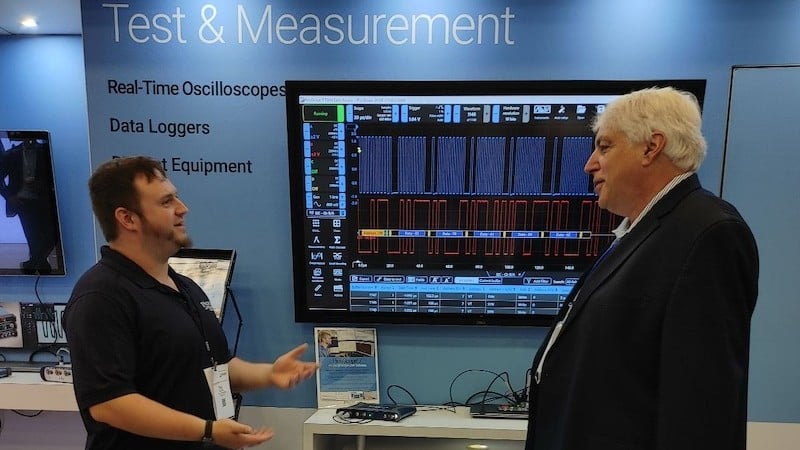
Jeff Child (right) talks with Pico Technology’s technical applications engineer Ben Ellis (left) at Embedded World 2024.
Key features of the new MSO models include:
- 500 MHz bandwidth, 5 GS/s sampling rate, and 10-bit resolution: These specifications ensure high-fidelity signal capture across a wide range of applications, from RF and communications to power electronics and automotive systems.
- 2 GS ultra-deep capture memory and up to two million waveforms per second: Enables the capture of long-duration signals at maximum sampling rate or many shots that are very close to each other.
- 200 MS/s 14-bit AWG / function generator: Offers real-world waveform generation capabilities for a wide range of applications, eliminating the need for additional external equipment.
- 16 digital channels: The MSO models provide 16 digital inputs, offering engineers the ability to simultaneously capture and analyze both analog and digital signals, perfect for mixed-signal designs such as microcontroller or FPGA-based systems.
- USB 3.0 Type-C connected and powered: Ensures high-speed data transfer and compatibility with the latest generation of PCs, simplifying connectivity and setup. An adaptor for earlier USB port types is provided.
Taoglas Debuts Its ‘Industry First’ Wi-Fi Antenna for an RJ45 Jack
At the show, Taoglas unveiled AntJack, a high-efficiency Wi-Fi antenna that is mounted on a standard RJ45 ethernet connector. The new FXM100 Wi-Fi antenna can be mounted on Taoglas’ TMJG4926HENL or any standard 1×1 RJ45 connector to create a 2-in-1 solution, providing designers space-saving options and layout flexibility to improve wireless coverage across 2.4 GHz, 5.8 GHz, and 7.1 GHz bands.
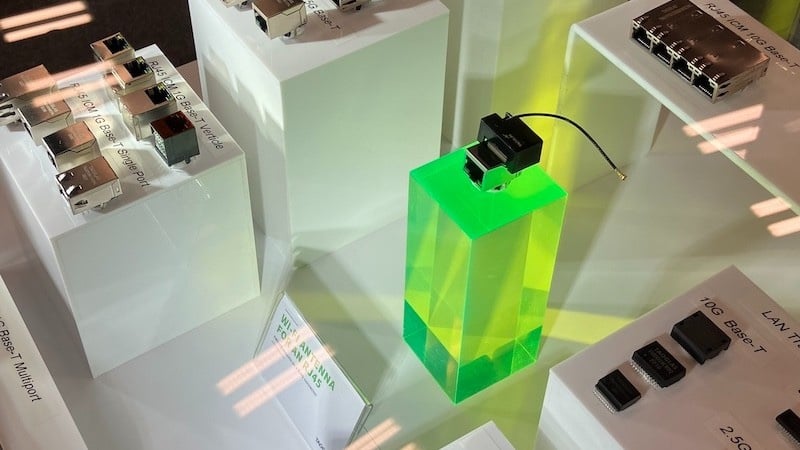
Close-up image of the FXM100 at Embedded World North America.
By mounting the antenna on the jack, the antenna is removed from the PCB freeing up valuable real estate and uses the jack as the antenna ground plane to deliver better wireless performance. The FXM100 omnidirectional dipole antenna supports Bluetooth, Wi-Fi 6 / 6E, and Wi-Fi 7 and can be used in a variety of applications, including modems and routers, industrial gateways, factory automation, industrial robotics, and test and measurement systems.
AntJack is also ideal for complex MIMO designs where antenna location and positioning are critical, especially when space is a premium in 4×4 or 8×8 MIMO configurations. In addition to layout constraints, designers are often forced to work around proximity to metal which causes interference and signal distortion.
Antenna features and benefits:
- Wideband coverage—excellent antenna efficiency across 2.4 GHz, 5.8 GHz and 7.1 GHz bands.
- Small form factor—26.6 x 15.6 x 13.1 mm antenna with customizable cable and connector.
- Easy “peel and stick” mounting—manufactured from flexible PCB material with adhesive conductive foam.
Embedded World NA 24—Quick Briefs
- Analog Devices launched CodeFusion, a suite of developer-centric offerings that unite cross-device, cross-market hardware, software and services to help engineers deliver innovations for the Intelligent Edge with enhanced speed and security. It includes an embedded software development environment based on Microsoft’s Visual Studio code.
- Kontron launched the K4021-U mSTX motherboard. Based on the latest Intel Core Ultra 7 and 5 processors (SoC), the motherboard is designed for compute-intensive AI workloads such as image recognition and automation. With an integrated Neural Processing Unit (NPU), the K4021-U delivers up to 20x performance-per-watt with comparatively low power consumption.
- Blecon announced a $4.6M seed funding round. Blecon’s technology eliminates the need for 1:1 pairing and enables both existing smartphones and dedicated cellular hubs to act as hotspots. The funding, led by MMC Ventures, is expected to enable Blecon to further strengthen product development and expand customer engagements.
- Silicon Labs revealed new details on their next-generation Series 3 platform. The company says its Series 3 devices will be able to answer the challenges that the continued acceleration of IoT poses: demands for more processing power at far-edge devices across all IoT applications across many industries.
- DFI announced the RPS101/RPS103 Mini-ITX motherboard. It is engineered to support the latest 14th/13th/12th Gen Intel Core processors and R680E, Q670E and H610E chipsets, and up to 64 GB of DDR5 4800 MHz memory.