
 Facebook
 Google
 GitHub
 Linkedin
Basic Electricity
Basic Troubleshooting Strategies
15 questions By Tony R. Kuphaldt
-
Question 10 of 15
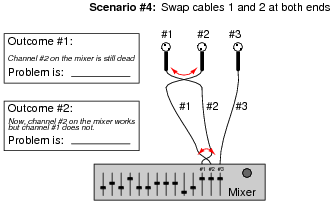
A music recording studio is equipped with three microphones, each of which connect to the “mixer” panel by means of shielded cables:

The purpose of the mixer is to function as a multi-channel audio signal amplifier, to control the volume of each sound channel so that a good “mix” is obtained for recording. The studio engineer will use the individual controls on the mixer to “blend” the inputs for the best recording tone and quality.
This system has a problem, though. Microphone #2 seems to be “dead,” meaning that channel #2 on the mixer does not register any signal when the singer sings into that microphone. All the other channels are working just fine, though.
Being the studio technician, you job is to troubleshoot this problem in the shortest time possible. Unfortunately, in your rush to get to the job site you forgot to bring your test equipment. That isn’t a problem, however, because you know how to troubleshoot systems by swapping interchangeable components.
I will present four different “swap” scenarios to you, with two different outcomes for each. Your task is to declare what is known about the location of the fault based on these scenarios and outcomes.


Reveal answerScenario #1, outcome #1: problem is not in the microphone.
Scenario #2, outcome #2: microphone #2 is faulty.
Scenario #2, outcome #1: problem is not in the microphone.
Scenario #2, outcome #2: microphone #2 is faulty.
Scenario #3, outcome #1: mixer input #2 is faulty.
Scenario #3, outcome #2: the problem is not in the mixer.
Scenario #4, outcome #1: the problem is not in the cable.
Scenario #4, outcome #2: cable #2 is faulty.
Notes:Your more adept students will immediately recognize that scenarios 1 and 2 are really quite the same. The logical thinking behind this troubleshooting strategy may confound some of your students, so be prepared to spend adequate time covering and re-covering (if necessary) this question. By the way, this type of question is excellent for a written test!
-
Question 11 of 15
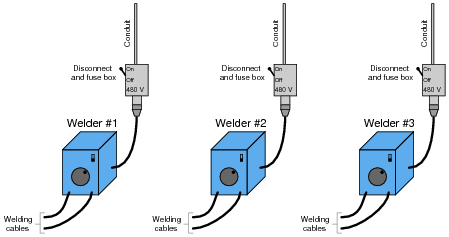
At a construction site, several electric “arc” welders are plugged into 480 volt receptacles. Each receptacle has its own safety disconnect switch and fuse overcurrent protection:
You, as an electronics technician working at the job site, happen to be walking past these welders when one of the welding personnel stops you to ask for help.
“You’re an electrician, right?”
“Not exactly,” you reply, “but maybe I can help you anyway.”
“My welder’s dead - it doesn’t even turn on. Can you check it out?”
You didn’t bring your multimeter or any other test equipment, so you can’t check for voltage at the receptacle. As you look around the job site, you notice that no one is using welder #2. When you flip it’s power switch on, welder #2 turns on just like it should. Deciding to apply your ßwap interchangeable components” troubleshooting strategy, you turn off both welders’ power switches, then turn off the disconnect switches at both receptacles and swap the power cables between receptacles:

When you turn the disconnect switches on and try to start both welders, you find that neither one turns on now! Switching the power cables back to their original receptacles doesn’t make things better, either. Both welders #1 and #2 are still “dead,” which is a worse situation than what you first encountered. This is not good, because the person who called you for help is beginning to cast angry looks in your direction, and you are fairly sure the operator of welder #2 won’t be much happier when he returns to find his welder non-functional as well.
Identify the most likely location of the fault in this system, and explain why the ßwap interchangeable components” strategy got you into trouble.
Reveal answerThe likely location of the fault is in welder #1. I’ll let you determine what the nature of this fault most likely is, and why the strategy employed in this scenario probably wasn’t the wisest.
Notes:This situation is very realistic, and underscores the need for careful thinking on the part of the troubleshooter when deciding what specific troubleshooting strategy to apply. Despite the undeniable power of the “swap interchangeable components” strategy, it is not fool-proof.
-
Question 12 of 15
A friend of yours brings you their damaged stereo amplifier, hoping that perhaps you would be able to repair it cheaper than the local electronics repair shop. The amplifier was damaged at a recent party, when one of your friend’s guests turned up the volume to full and left it there until smoke billowed out of the power amplifier chassis.
Your friend has already done some troubleshooting of his own: after turning off the amplifier and letting the smoke clear, he turned it back on at low volume to find that the left channel is dead, but the right channel is still working. He then swapped speakers and speaker wires, and consistently found that whatever speaker was plugged into the left channel did not make sound, but the speaker plugged into the right channel always did.
You remove the chassis cover on the amplifier and look inside. There, the damage is visually apparent: both of the power transistors for the left channel output are burnt beyond recognition. You unsolder the transistors from the circuit board and unscrew them from the heat sink, but you cannot read the part numbers on their cases due to the thermal damage. This is not good, because without knowing the proper part numbers, your friend cannot order the proper replacement transistors to repair the amplifier.
As usual, there is no schematic diagram supplied with this amplifier that would indicate the proper part numbers. What do you do?
Reveal answerRead the part numbers off the power transistors for the right channel output!
Notes:Some students may question this logic, believing that the left and right channels of a stereo amplifier would be mirror-symmetric rather than identical, and thus possibly contain different components. You may answer this objection by appealing to the indistinguishable sound of the two channels, when listened to separately (mono). There is nothing “right-handed” or “left-handed” about the two channels. Each one is identical to the other at the circuit level, because each channel is expected to perform exactly the same.



I have a question about troubleshooting.
As a technician you were asked to troubleshoot a pieces of electronic equipment which contains various electronic components . On opening the door of the cabinet, you perceived a pungent smell and in addition you observed the following:
1. There were some dirt and corrosion on the circuit board
2. One of the capacitor was discolored.
3. One of the leads of the transistor was broken..
Please I need an urgent answer please….