Facebook
 Google
 GitHub
 Linkedin
Basic Electricity
Electrical Connections
13 questions By Tony R. Kuphaldt
-
Question 10 of 13
Show how to build a simple circuit consisting of a battery, a lamp, and a switch, mounting the lamp and switch on a solderless breadboard (also known as a proto-board):
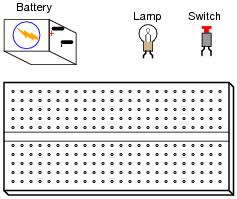
Reveal answerThis is just one possibility - there are many others!

Notes:Solderless breadboards are extremely useful tools for prototyping circuits in a classroom/lab environment. Familiarity with their use is a virtual necessity for any modern electronics curriculum. That being said, it is important not to over-emphasize breadboards, though. I have seen some electronics courses where breadboards are the only form of circuit construction students ever use! This does not prepare them for challenges of the job, where breadboards are (rightfully) used only for prototyping.
In summary, use breadboards in your students’ labwork, but not all the time, or even most of the time!
-
Question 11 of 13
What is soldering? What is solder?
Reveal answer“Soldering” is a low-temperature form of welding commonly used to join electrical conductors together for permanent connections.
“Solder” is a special alloy of metals designed to melt at a low temperature, to make permanent electrical connections.
Notes:It should be noted that not all forms of soldering are “low temperature.” Silver soldering, for example, takes place at much greater temperatures than regular electrical soldering. However, all soldering is a form of welding.
-
Question 12 of 13
An alternative to soldering components into printed circuit boards is to use a technique called wire wrap. Describe what “wire wrap” is and what applications it might be suitable for.
Reveal answer“Wire wrap” is a connection technique for joining components together on a circuit board without need for pre-printed copper “traces” on the board. Instead, small-gauge wire is tightly wrapped around the pins of each component, with the wire making point-to-point connections between components.
Notes:Though wire-wrapping is not as prevalent now as it was a few decades ago, it still has merit for certain applications, notably prototyping. If possible, have some wire-wrapped circuit boards available to show your students during discussion time.