
 Facebook
 Google
 GitHub
 Linkedin
Discrete Semiconductor Devices and Circuits
Electron Versus Conventional Flow
10 questions By Tony R. Kuphaldt
-
Question 7 of 10
Two people are debating electron flow versus conventional flow. One of them says that the you will get different results predicting polarity of voltage drops in a resistive circuit depending on which convention you use. The other person says the convention for labeling current does not matter at all, and that the correct polarities will be predicted either way.
Which of these two people is correct? Explain why, and give an example to prove your point.
Reveal answerI will let pictures show the answer to this question:
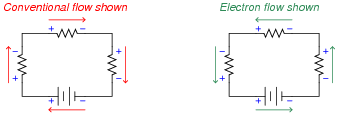
Notes:It is important to remember that there is only one convention for using “ ” and “-” symbols to designate the polarity of a voltage drop (thankfully!).
-
Question 8 of 10
Suppose a person is more familiar with conventional flow notation than electron flow notation. If this person find themselves in a situation where they must draw the direction of current according to electron flow notation, what advice would you give them for making the transition.
Reveal answerBegin by drawing all currents in the more familiar notation of conventional flow, then reverse each and every arrow!
Notes:A good strategy might be to use a pencil and lightly draw the arrows in the direction of conventional flow, then over-draw those arrows in the reverse direction using more hand pressure (making a darker line).
It should go without saying that this technique works just as well for the person who is more comfortable with electron flow notation, but must switch to conventional flow for some reason.
-
Question 9 of 10
A Cathode Ray Tube, or CRT, is the heart of an analog oscilloscope. It functions by aiming a focused beam of electrons at a phosphorescent screen, causing light at the point of impact:
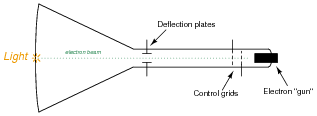
What style of current notation (electron or conventional) would best suit a description for the operation of a CRT?
Reveal answerAs with most electron tubes, electron flow makes the most sense of a CRT’s operation.
Notes:The answer given provides a clue as to why electron flow notation is still popular among technicians and the institutions that train them. There is a legacy of electron-flow-based instruction originating from the days when vacuum tubes were the predominant active component in electronic circuits. If you are teaching the operation of these devices in the simplest terms, so that non-engineers can understand them, it would make the most sense to standardize on a notation for current that follows the actual electrons. Electrical engineers, on the other hand, established their own convention for designating direction of current before the electron was even discovered, which is why that branch of electrical science still denotes the direction of current opposite the direction of electron motion.


