Facebook
 Google
 GitHub
 Linkedin
Analog Integrated Circuits
Nonlinear OpAmp Circuits
17 questions By Tony R. Kuphaldt
-
Question 7 of 17
Identify the mathematical function of this circuit (if you look closely, you’ll notice that the transistors are connected in such a way that they act very similar to diodes):
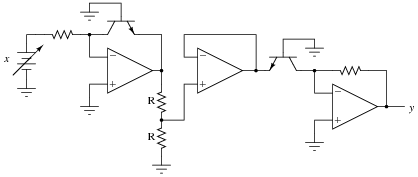
Note: the two resistors labeled “R” are equal in value.
Reveal answerThis circuit takes the square root of the input signal (y = √x).
Follow-up question: how could we modify this circuit so as to take the cube root of the input signal?
Notes:This circuit is not nearly as complex as it may appear at first, if students take the time to isolate it section-by-section and identify the mathematical function each section performs.
-
Question 8 of 17
Identify the mathematical function of this circuit (if you look closely, you’ll notice that the transistors are connected in such a way that they act very similar to diodes):
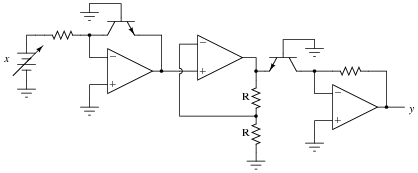
Note: the two resistors labeled “R” are equal in value.
Reveal answerThis circuit squares the input signal (y = x2).
Challenge question: why are transistors used instead of diodes, since they have been effectively “disabled” to act as such?
Notes:This circuit is not nearly as complex as it may appear at first, if students take the time to isolate it section-by-section and identify the mathematical function each section performs.
-
Question 9 of 17
Suppose that in the course of building this exponential circuit you encounter severe inaccuracies: the circuit seems to work some of the time, but often its output deviates substantially (as much as /- 10%) from what it ought to be:

Based on what you know of the components in this circuit, what could be varying so much as to cause these errors? What do you recommend as a solution to the problem?
Reveal answerThe solution is to make sure both transistors are precisely matched, at held at the exact same temperature:

Challenge question: is there a part we could order that contains two matched, heat-stabilized transistors for an application such as this? Are there any other circuit applications you can think of that could benefit from using a precision-matched pair of transistors?
Notes:Ask your students to explain how they know temperature is an influencing factor in the accuracy of this circuit. Ask them to show any equations describing transistor behavior that demonstrate temperature dependence.
This question provides an opportunity to review the meaning of fractional exponents with your students. What, exactly, does y = x0.5 mean? Ask your students to write this expression using more common symbols. Also, ask them what would have to be modified in this circuit to alter the exponent’s value.
As for the challenge question, ask your students to produce a part number for the precision-matched transistor pair they find. Where did they obtain the information on this component?