Facebook
 Google
 GitHub
 Linkedin
Analog Integrated Circuits
Nonlinear OpAmp Circuits
17 questions By Tony R. Kuphaldt
-
Question 4 of 17
Plot the transfer function (Vout versus Vin) for this opamp circuit, and explain how the circuit works:
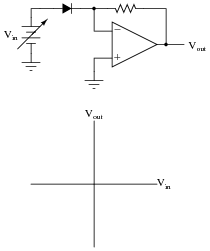
What type of mathematical function is represented by this circuit?
Reveal answerThis circuit represents an exponential function (y ∝ ex):
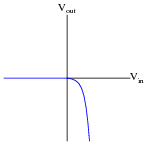
Notes:The direction of the transfer function curve may surprise some students. Ask them why the curve goes down (negative) for increasingly positive input voltages.
-
Question 5 of 17
Plot the transfer function (Vout versus Vin) for this opamp circuit, and explain how the circuit works:

What type of mathematical function is represented by this circuit?
Reveal answerThis circuit represents a logarithmic function (y ∝ lnx):
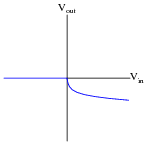
Notes:The direction of the transfer function curve may surprise some students. Ask them why the curve goes down (negative) for increasingly positive input voltages.
Ask your students how they obtained this transfer function curve. There are conceptual methods for obtaining it, as well as algebraic methods. It would be interesting to compare more than one of these methods in a class discussion, and have students gain insight from each others’ methods.
-
Question 6 of 17
Plot the transfer function (Vout versus Vin) for this opamp circuit:
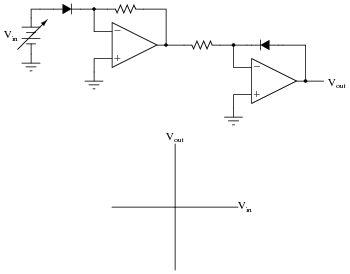
What type of mathematical function is represented by this circuit?
Reveal answerThis circuit (ideally) represents a linear function (y ∝ x):
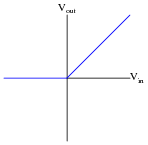
Notes:It should be obvious from inspection that the two opamp circuits represent inverse mathematical functions. Ask your students why the final transfer function is linear rather than nonlinear. After all, they should realize that each of the opamp circuits, taken individually, are very nonlinear. Why would their combined effect be linear?
An interesting exercise would be to have your students perform inverse functions like this on their hand calculators, first calculating an exponential function (f(x) = ex), then a logarithmic (g(x) = lnx), and verifying the combined functions’ output (f[g(x)] = x).