Facebook
 Google
 GitHub
 Linkedin
Analog Integrated Circuits
Nonlinear OpAmp Circuits
17 questions By Tony R. Kuphaldt
-
Question 13 of 17
Predict how the operation of this logarithm extractor circuit will be affected as a result of the following faults. Consider each fault independently (i.e. one at a time, no multiple faults):
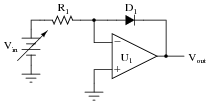
- Resistor R1 fails open:
- Solder bridge (short) across resistor R1:
- Diode D1 fails open:
- Diode D1 fails shorted:
For each of these conditions, explain why the resulting effects will occur.
Reveal answer- Resistor R1 fails open: Vout goes to zero volts.
- Solder bridge (short) across resistor R1: Vout saturates in the negative direction.
- Diode D1 fails open: Vout saturates in the negative direction.
- Diode D1 fails shorted: Vout goes to zero volts.
Notes:The purpose of this question is to approach the domain of circuit troubleshooting from a perspective of knowing what the fault is, rather than only knowing what the symptoms are. Although this is not necessarily a realistic perspective, it helps students build the foundational knowledge necessary to diagnose a faulted circuit from empirical data. Questions such as this should be followed (eventually) by other questions asking students to identify likely faults based on measurements.
-
Question 14 of 17
Explain why carefully matched resistors and transistors are necessary in log/antilog circuits, using your own words. Also, explain why the operational amplifiers themselves need not be matched as precisely as the discrete components.
Reveal answerI said, “your own words,” not mine! What are you looking here for?
Notes:This question challenges students to identify the “weak points” of log/antilog circuits, explaining why certain component tolerances are critical and others are not. This is a good test of students’ understanding regarding log/antilog circuits and their underlying theory.
-
Question 15 of 17
This square root extraction circuit used to work fine, but then one day it stopped outputting the square root of the input signal, and instead simply reproduced the input signal with a gain of 1:
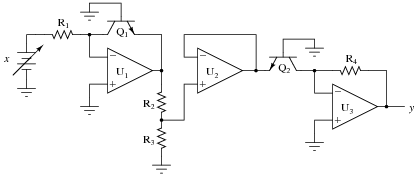
What could have gone wrong with this circuit to cause it to stop “calculating” the square root of the input? Be as detailed as possible in your answer.
Reveal answerPossibly R2 failed shorted or R3 failed open. I’ll let you explain why either of these faults could cause the problem described.
Notes:One must understand what is happening in this circuit and why in order to successfully diagnose the problem. Discuss this carefully with your students.