Facebook
 Google
 GitHub
 Linkedin
Analog Integrated Circuits
Nonlinear OpAmp Circuits
17 questions By Tony R. Kuphaldt
-
Question 16 of 17
Identify at least two independent component faults which could cause this square root extraction circuit to always output 0 volts instead of the square root of input voltage x as it should:
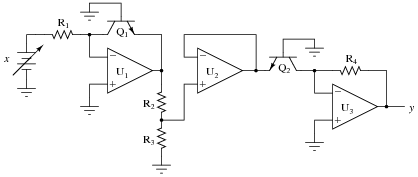
Explain why each of your proposed faults would cause the output to stay at 0 volts.
Reveal answerHere are just a few possibilities: resistor R2 failed open, solder bridge across resistor R3, Q2 failed open.
Notes:Students will likely identify opamp U3 as a potential fault, but this is really too easy. Encourage them to seek more interesting fault possibilities!
-
Question 17 of 17
In the early 1970’s, the Fluke company invented a revolutionary new “RMS sensor” integrated circuit, used to convert an arbitrary waveform into its DC-equivalent (RMS) voltage. The device uses two precision resistors to heat a pair of matched transistors connected as a differential pair:
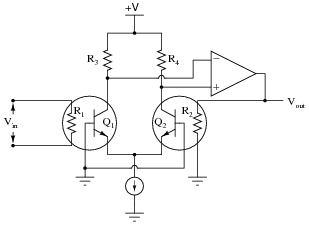
Describe how this circuit functions. What physical principle(s) does it use to derive an RMS value for Vin? Why is it important that all identical components (transistors, resistors) be precisely matched?
Reveal answerThis circuit exploits the temperature sensitivity of transistors to sense thermal balance between the two resistors R1 and R2. By definition, whatever DC voltage produces the same heat dissipation in a given resistance as an AC voltage is the RMS value of that AC voltage.
Notes:This question provides a good opportunity to review the function of differential pair circuits, and also the concept of RMS AC measurement. Ask your students how temperature influences the conductivity of bipolar junction transistors, and how the opamp’s connection to resistor R2 forms a negative feedback loop.