Facebook
 Google
 GitHub
 Linkedin
Basic Electricity
Overcurrent Protection
13 questions By Tony R. Kuphaldt
-
Question 4 of 13
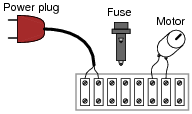
Show the proper placement of the fuse in this circuit, where an electric motor will be powered by utility (120 volt AC) power:
Reveal answer
Notes:You can redirect this question into one more general: should fuses be connected in series with the load, or in parallel with the load? Have your students explain their choices, based on their knowledge of series and parallel circuits.
-
Question 5 of 13
Are fuses and circuit breakers located at a power distribution panel rated to protect the wiring from overcurrent, or to protect the load devices from overcurrent? Explain your answer.
Reveal answerGenerally speaking, distribution panel overcurrent protection devices are rated in such a way as to protect the wiring, not the load devices.
Follow-up question: suppose a computer with a 300 watt power supply is plugged into a receptacle, which is serviced by a circuit breaker rated at 15 amps. Where in the circuit would it be best to install an overcurrent protection device for protecting the computer from burning itself up in the event of an internal failure?
Notes:This lesson is very important for students to learn: that panel-mounted overcurrent protection devices are rated to protect the wiring they supply power to, and nothing else. Of course, there are exceptions to this rule in large industrial power systems.
-
Question 6 of 13
In an effort to obtain greater overcurrent ratings than a single fuse can provide, an engineer decides to wire two 100 amp fuses in parallel, for a combined rating of 200 amps:

However, after a few years of operation, the system begins blowing fuses even when the ammeter registers less than 200 amps of load current. Upon investigation, it is found that one of the fuse holders had developed corrosion on a terminal lug where one of the wire connects:

Explain how a small accumulation of corrosion led to this condition of fuses blowing when there was no overcurrent condition (load current less than 200 amps), and also why connecting fuses in parallel like this is generally not a good idea.
Reveal answerHere is an electrical calculation to help explain the fuse-blowing problem. Calculate the current through each resistor in this circuit:
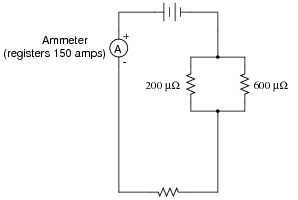
Notes:Ask your students to explain what happens to current in a circuit when it branches from one path into two or more parallel paths. Discuss how the proportionality of the current “split” between those paths depends on the relative resistances of those two paths.
Even if your students have not yet studied current divider circuits, this question provides an excellent opportunity to explore the concept.
Incidentally, it is now common for some manufacturers of residential power distribution equipment to “gang” circuit breakers together in parallel for added overcurrent capacity. This engineering practice is questionable for the exact same reason it is questionable with the fuses in this scenario: any amount of corrosion or other infiltration of electrical resistance into one of the parallel “legs” offsets the split of current between the paralleled overcurrent protection devices, forcing one of them to handle a disproportionately large share of the total current (and therefore trip sooner).