Facebook
 Google
 GitHub
 Linkedin
Basic Electricity
Parallel DC Circuits Practice Worksheet With Answers
24 questions By Tony R. Kuphaldt
-
Question 22 of 24
Suppose you needed a resistance equal to precisely 235 Ω for the construction of a precision electrical meter circuit. The only resistors available to you are two 1 kΩ resistors, one 500 Ω resistor, and a rheostat variable between 600 and 1000 ohms. Design a parallel resistor network using any combination of these components that will yield a total resistance of 235 Ω. If you use the rheostat in your design, specify its resistance setting.
Reveal answer
Notes:This problem is an exercise in estimation, and algebraic equation manipulation. Estimation will reveal which resistors should be combined together, and algebraic manipulation will give the exact values needed.
-
Question 23 of 24
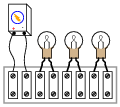
Draw the connecting wires on this terminal strip so that the three light bulbs are wired in parallel with each other and with the battery.
Reveal answer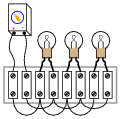
Notes:One of the more difficult visualization tasks for new students of electronics is translating schematic diagrams to physical layouts, and visa-versa. This, sadly, is a skill that I don’t see emphasized nearly enough in most basic electronics curricula. It seems the majority of class time is spent mathematically analyzing useless resistor networks, and not enough time is invested building students’ spatial relations skills.
While series connections are very easy to visualize on terminal strips, parallel connections are more difficult. Work with your students through this question helping those who lack the innate spatial relations ability to see the solution quickly.
A “trick” I often use to help students build this skill is to have them first draw a nice, clean schematic diagram. Then they over-trace each wire in the diagram as they draw it in the pictorial diagram. In this way, they make sure not to overlook connections in the pictorial diagram.
-
Question 24 of 24
Choose two resistor values such that one resistor passes 25% of the total current, while the other resistor passes 75% of the total current:

Reveal answerThere are many combinations of resistor values that will satisfy these criteria.
Notes:This is a fine example of a question with multiple correct answers. No matter how many unique combinations students invent, they may all be verified by a few simple Ohm’s Law calculations.