Facebook
 Google
 GitHub
 Linkedin
Basic Electricity
Parallel DC Circuits Practice Worksheet With Answers
24 questions By Tony R. Kuphaldt
-
Question 10 of 24
Qualitatively compare the voltage and current for each of the three light bulbs in this circuit (assume the three light bulbs are absolutely identical):
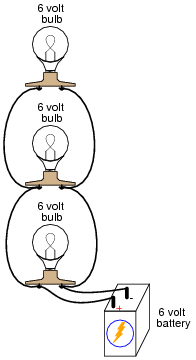
Reveal answerThe voltage dropped across each of the lights bulbs is guaranteed to be equal. The current through each of the light bulbs, in this particular case (with identical bulbs), happens to be equal.
Notes:Here, the important principles of voltage and current in a parallel circuit are highlighted. This question serves to further define, in practical ways, what the term “parallel” really means.
An important lesson of this question is the distinction between measurements which are guaranteed to be equal versus measurements which just happen to be equal for a given selection of components.
-
Question 11 of 24
Calculate the total amount of current that the battery must supply to this parallel circuit:

Now, using Ohm’s Law, calculate total resistance (Rtotal) from total (source) voltage Vtotal and total (source) current Itotal.
Reveal answerItotal = 40.0 mA
Rtotal = 250 Ω
Follow-up question: without appealing to Ohm’s Law, explain why the total resistance is one-half as much as either of the individual resistances.
Notes:While some students seem able to immediately grasp the concept of parallel resistances diminishing in (total) value, it is worthwhile to approach it from an Ohm’s Law perspective as well to give other students a more formal rationale for this effect.
-
Question 12 of 24
Suppose I connect two resistors in parallel with one another, like this:

How much electrical resistance would you expect an ohmmeter to indicate if it were connected across the combination of these two parallel-connected resistors?
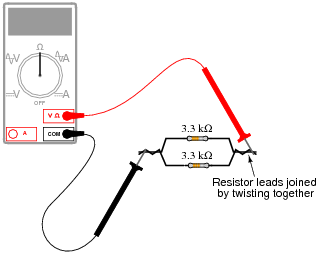
Explain the reasoning behind your answer, and try to formulate a generalization for all combinations of parallel resistances.
Reveal answer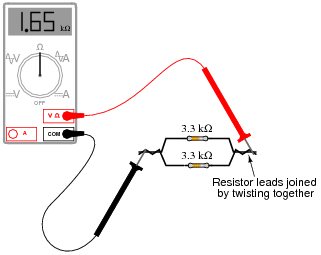
Follow-up question: how much resistance would you expect the ohmmeter to register if there were three similarly-sized resistors connected in parallel instead of two? What if there were four resistors?
Notes:The concept of parallel (total) resistance, in relation to individual resistances, often confuses new students. Be sure to allow plenty of discussion time to work through the conceptual difficulties with them.