Facebook
 Google
 GitHub
 Linkedin
Analog Integrated Circuits
Phase-Locked Loops
8 questions By Tony R. Kuphaldt
-
Question 7 of 8
Define the following terms, as they relate to phase-locked loop circuits:
- Center frequency
- Lock range
- Capture range
- Lock-up time
Reveal answer- Center frequency: the “free-running” frequency of a PLL’s voltage-controlled oscillator.
- Lock range: the range of input signal frequencies that a PLL is able to remain “locked in” to.
- Capture range: the range of input signal frequencies that a PLL is able to lock in to, from an unlocked state.
- Lock-up time: the amount of time required for a PLL to “lock in” to a given input frequency, from a cold start.
Notes:Ask your students to explain which range - lock or capture - is narrower, and why.
-
Question 8 of 8
“FM” means “frequency modulation,” and it refers to the encoding of a waveform by changing (modulating) the frequency of another. This is the technology used in broadcast FM radio transmission:
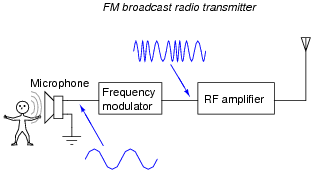
This is how FM radio communication works: by modulating the frequency of a radio-frequency (RF) signal according to the amplitude of the voltage signal produced by a microphone.
Explain how a phase-locked loop circuit could be used to “demodulate” the output of an FM radio station, so as to extract the broadcaster’s audio signal from the RF waveform.
Reveal answerThis diagram, of course, shows a much-simplified system for FM demodulation:
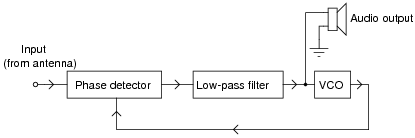
Notes:Despite the crudeness of the answer given, the basic operational theory of a PLL demodulator should be apparent for students to see. Discuss the operation of this circuit with your students, making sure all of them comprehend the purpose of a PLL.