Facebook
 Google
 GitHub
 Linkedin
Analog Integrated Circuits
Op-amp Circuits
12 questions By Tony R. Kuphaldt
-
Question 7 of 12
A comparator is used as a high wind speed alarm in this circuit, triggering an audio tone to sound whenever the wind speed exceeds a pre-set alarm point:

The circuit works well to warn of high wind speed, but when the wind speed is just near the threshold level, every little gust causes the alarm to briefly sound, then turn off again. What would be better is for the alarm to sound at a set wind speed, then stay on until the wind speed falls below a substantially lower threshold value (example: alarm at 60 km/h, reset at 50 km/h).
An experienced electronics technician decides to add this functionality to the circuit by adding two resistors:
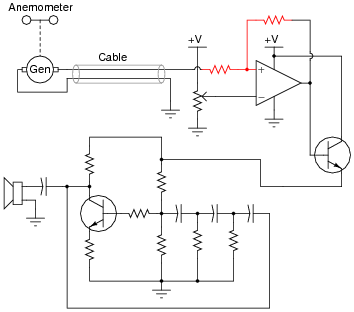
Explain why this circuit alteration works to solve the problem.
Reveal answerThe added resistors provide positive feedback to the opamp circuit, causing it to exhibit hysteresis.
Challenge question: suppose you wished to increase the gap between the upper and lower alarm thresholds. What resistor value(s) would you have to alter to accomplish this adjustment?
Notes:A practical illustration for positive feedback in an opamp circuit. There is much to discuss here, even beyond the immediate context of positive feedback. Take for instance the oscillator circuit and on/off control transistor. For review, ask your students to explain how both these circuit sections function.
-
Question 8 of 12
Assume that the comparator in this circuit is capable of “swinging” its output fully from rail to rail. Calculate the upper and lower threshold voltages, given the resistor values shown:
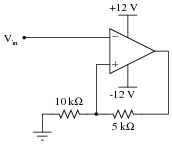
VUT = VLT =
Reveal answerVUT = 8 volts
VLT = -8 volts
Challenge question: how would you recommend we change the circuit to give threshold voltages of 6 volts and -6 volts, respectively?
Notes:Ask your students to explain what the terms “upper threshold” and “lower threshold” mean with regard to input voltage in a circuit such as this.
-
Question 9 of 12
Assume that the comparator in this circuit is only capable of “swinging” its output to within 1 volt of its power supply rail voltages. Calculate the upper and lower threshold voltages, given the resistor values shown:

VUT = VLT =
Reveal answerVUT = 4.087 volts
VLT = -4.087 volts
Notes:As many opamps and comparators are incapable of rail-to-rail output swings, this question is quite realistic.