Facebook
 Google
 GitHub
 Linkedin
Analog Integrated Circuits
Op-amp Circuits
12 questions By Tony R. Kuphaldt
-
Question 4 of 12
One analogy used to explain and contrast negative feedback versus positive feedback is that of a round stone, placed on either a hilltop or a valley:
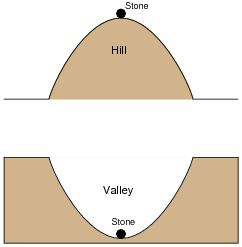
The stability of the stone in each of these scenarios represents the stability of a specific type of electrical feedback system. Which of these scenarios represents negative feedback, which represents positive feedback, and why?
Reveal answerThe valley represents negative feedback, while the hill represents positive feedback.
Notes:I have found this simple analogy to be most helpful when explaining feedback systems to students, because the behavior of each is intuitively obvious.
-
Question 5 of 12
A student intends to connect a TL082 opamp as a voltage follower, to “follow” the voltage generated by a potentiometer, but makes a mistake in the breadboard wiring:
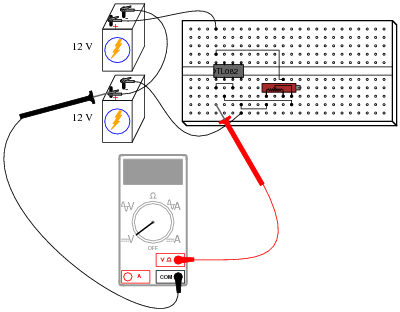
Draw a schematic diagram of this faulty circuit, and determine what the voltmeter’s indication will be, explaining why it is such.
Reveal answerCircuit schematic, as wired:

The output voltage will saturate at approximately 11 volts, or -11 volts, with the potentiometer having little or no effect.
Notes:Ask your students to characterize the type of feedback exhibited in this circuit. How does this type of feedback affect the opamp’s behavior? Is it possible for the opamp to function as a voltage follower, connected like this?
-
Question 6 of 12
Determine the “trip” voltage of this comparator circuit: the value of input voltage at which the opamp’s output changes state from fully positive to fully negative or visa-versa:

Now, what do you suppose would happen if the output were fed back to the noninverting input through a resistor? You answer merely has to be qualitative, not quantitative:
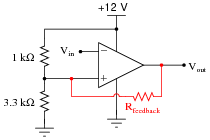
For your information, this circuit configuration is often referred to as a Schmitt trigger.
Reveal answerWith no feedback resistor, the “trip” voltage would be 9.21 volts. With the feedback resistor in place, the “trip” voltage would change depending on the state of the opamp’s output!
Follow-up question: describe what effect this changing “trip” voltage value will have on the operation of this comparator circuit.
Notes:Schmitt trigger circuits are very popular for their ability to “cleanly” change states given a noisy input signal. I have intentionally avoided numerical calculations in this question, so that students may concentrate on the concept of positive feedback and how it affects this circuit.