Facebook
 Google
 GitHub
 Linkedin
Analog Integrated Circuits
Op-amp Circuits
12 questions By Tony R. Kuphaldt
-
Question 10 of 12
Assume that the comparator in this circuit is only capable of “swinging” its output to within 1 volt of its power supply rail voltages. Calculate the upper and lower threshold voltages, given the resistor values shown:

VUT = VLT =
Reveal answerVUT = 10.29 volts
VLT = -10.29 volts
Challenge question: how would you recommend we change the circuit so that its threshold voltages are centered around some voltage value other than zero?
Notes:As many opamps and comparators are incapable of rail-to-rail output swings, this question is quite realistic.
-
Question 11 of 12
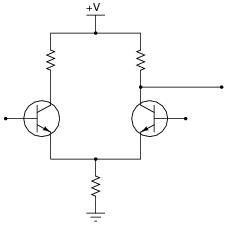
Comparators with positive feedback are sometimes referred to as Schmitt triggers. Suppose you needed a Schmitt trigger for a circuit you were building, but did not have any more integrated circuit comparators or op-amps to use. All you have available to you are discrete components. Is there any way you can think of to modify the following discrete transistor differential pair so that it behaves as a Schmitt trigger?
Reveal answer
Notes:Ask your students to determine whether this Schmitt trigger circuit is inverting or non-inverting. Have them explain their reasoning step-by-step.
Authors Paul Horowitz and Winfield Hill, in their book
The Art of Electronics, say that Q1‘s collector resistor must be larger than Q2‘s collector resistor in order for this circuit to work properly (page 232, second edition).
-
Question 12 of 12
Positive or regenerative feedback is an essential characteristic of all oscillator circuits. Why, then, do comparator circuits utilizing positive feedback not oscillate? Instead of oscillating, the output of a comparator circuit with positive feedback simply saturates to one of its two rail voltage values. Explain this.
Reveal answerThe positive feedback used in oscillator circuits is always phase-shifted 360o, while the positive feedback used in comparator circuits has no phase shift at all, being direct-coupled.
Notes:This is a challenging question, and may not be suitable for all students. Basically, what I’m trying to get students to do here is think carefully about the nature of positive feedback as used in comparator circuits, versus as it’s used in oscillator circuits. Students who have simply memorized the concept of “positive feedback causing oscillation” will fail to understand what is being asked in this question, much less understand the given answer.