Facebook
 Google
 GitHub
 Linkedin
Basic Electricity
Basic Ammeter Use
11 questions By Tony R. Kuphaldt
-
Question 4 of 11
What would happen if a multimeter were connected across the component labeled “C1” on this printed circuit board, as shown?
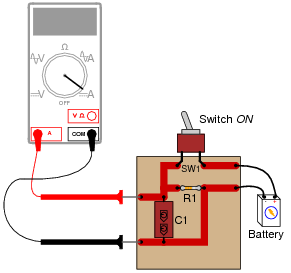
Reveal answerThe meter would create a short-circuit with the battery. Determine what damage this short-circuit might cause, to all components involved.
Notes:Even though it might not appear that the meter is “shorting” the battery in this example, it most certainly is. In asking students to determine the resulting damage from such an action, it is important for them to trace the path of “fault current” through the circuit. Those components within the path of fault current are in risk of damage, while those components not within the path of fault current are not at risk.
-
Question 5 of 11
If we were to connect an ammeter directly to an ohmmeter, what would you expect to see the ohmmeter register, for resistance between its test leads?
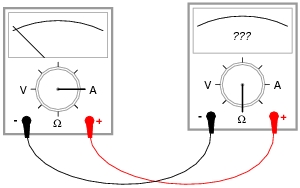
Reveal answerThe ohmmeter should register a very low resistance.
Notes:Ask your students why an ammeter should have a very low resistance (fractions of an ohm) between its test leads. How does this property of all ammeters relate to how they are used to measured current in real circuits?
-
Question 6 of 11
Most ammeters contain fuses inside to provide protection for the person using the ammeter, as well as for the ammeter mechanism itself. Voltmeters generally do not contain fuses inside, because they are unnecessary.
Explain why ammeters use fuses and voltmeters do not? What is it about the nature of an ammeter and how it is used that makes fuse-protection necessary?
Reveal answerThe purpose of the fuse inside the ammeter is to “blow” (open-circuit) in the event of excessive current through the meter.
Notes:This is a very important question for several reasons. First, it alerts students that ammeters are generally fuse-protected, and therefore they must be aware that this fuse could “blow” and render the ammeter inoperative. Secondly, it highlights one of the major differences between voltmeters and ammeters, and that is the amount of current typically handled by the respective meter types.