Facebook
 Google
 GitHub
 Linkedin
Basic Electricity
Basic Ammeter Use
11 questions By Tony R. Kuphaldt
-
Question 7 of 11
In this circuit, is the light bulb lit? Why or why not?
Also, compare the relative indications of the two ammeters (which ammeter registers the greatest amount of current, and which ammeter registers the least amount of current, or do they both register the same amount of current?).
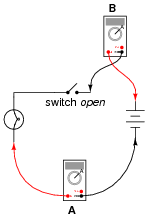
Reveal answerThe bulb is not lit, and the two ammeters both register 0 amperes of current.
Notes:It is vitally important for students to understand the significance of continuity throughout the entire circuit, not just at one or more points in the circuit.
-
Question 8 of 11
In this circuit, is the light bulb lit? Why or why not?
Also, compare the relative indications of the two ammeters (which ammeter registers the greatest amount of current, and which ammeter registers the least amount of current, or do they both register the same amount of current?).
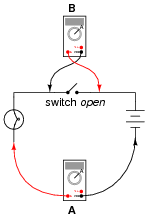
Reveal answerThe bulb is lit, and the two ammeters register equal amounts of current.
Notes:This is a good question to engage students’ thinking on meter properties. A voltmeter does not function the same as an ammeter, and the two different types of meters will impact circuits differently when connected! Incidentally, ammeters tend to get you into more trouble than voltmeters when troubleshooting circuits, which is why students should be encouraged to use a voltmeter whenever possible rather than an ammeter. Of course, clamp-on ammeters are not as unsafe as ammeters requiring direct connection with circuit conductors.
-
Question 9 of 11
In this circuit, is the light bulb lit? Why or why not?
Also, compare the relative indications of the two ammeters (which ammeter registers the greatest amount of current, and which ammeter registers the least amount of current, or do they both register the same amount of current?).
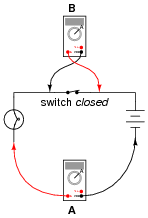
Reveal answerThe bulb is lit, but ammeter “A” registers much more current than ammeter “B”.
Notes:Exactly what ammeter “B” will register (aside from its indication being less then ammeter “A”), is an interesting question.