Facebook
 Google
 GitHub
 Linkedin
Basic Electricity
Basic Ammeter Use
11 questions By Tony R. Kuphaldt
-
Question 10 of 11
Generally speaking, is an ammeter supposed to be connected in series or in parallel with the component it’s measuring current through?
Reveal answerNotes:If your students don’t already know, this question is an excellent opportunity for them to learn about what a “series” circuit is and how it differs from a “parallel” circuit. Ask your students why “series” is the correct answer. What is it about a series connection that makes it the best type of connection to use an ammeter in? What would happen if we connected an ammeter in parallel with a circuit component?
-
Question 11 of 11
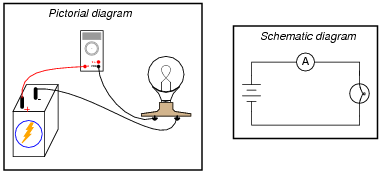
Ammeters must be connected in series with the current to be measured, to ensure that all the current moves through the meter:
In order to practically function, an ammeter must have some internal resistance. It is usually a very small amount, but it does exist. It should be apparent to you that the presence of this resistance will have some effect on the circuit current, when compared to the amount of current in the circuit without any meter connected:
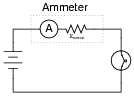
Explain why it is usually safe to ignore the internal resistance of an ammeter, though, when it is in a circuit. A common term used in electrical engineering to describe this intentional oversight is swamping. In this particular circuit an engineer would say, “The resistance of the light bulb swamps the internal resistance of the ammeter.”
Reveal answerWhen one quantity “swamps” another, we mean that its effect is huge compared to the effect of the other, so much so that we may safely ignore it in our calculations and still arrive at a reasonably accurate result.
Notes:I have found that the concept of “swamping” is extremely useful when making estimations. To be able to ignore the values of some components allows one to simplify a great many circuits, enabling easier calculations to be performed.