Facebook
 Google
 GitHub
 Linkedin
Basic Electricity
Basic Electricity Worksheet
38 questions By Tony R. Kuphaldt
-
Question 37 of 38
What do you think might happen if someone were to gently tap on the cone of one of these speakers? What would the other speaker do? In terms of electromagnetism and electromagnetic induction, explain what is happening.
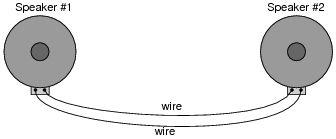
Reveal answerTry this experiment yourself, using a long pair of wires to separate the two speakers from each other by a significant distance. Listen and feel the speaker on your end while someone else taps on the other speaker, then trade roles.
Notes:Not only does this experiment illustrate the dual principles of electromagnetism and electromagnetic induction, but it also demonstrates how easy it is to set up a simple sound-powered audio telephony system.
It is highly recommended to have an identical pair of “woofer” speakers located in the classroom for this experiment, as well as a long length of twin-wire cable (an old piece of extension cord wire works well for this purpose, with alligator-clip “jumper” wires to make the connections).
-
Question 38 of 38
Suppose someone mechanically couples an electric motor to an electric generator, then electrically couples the two devices together in an effort to make a perpetual-motion machine:

Why won’t this assembly spin forever, once started?
Reveal answerThis will not work because neither the motor nor the generator is 100% efficient.
Notes:The easy answer to this question is “the Law of Conservation of Energy (or the Second Law of Thermodynamics) forbids it,” but citing such a “Law” really doesn’t explain why perpetual motion machines are doomed to failure. It is important for students to realize that reality is not bound to the physical “Laws” scientists set; rather, what we call “Laws” are actually just descriptions of regularities seen in nature. It is important to emphasize critical thinking in a question like this, for it is no more intellectually mature to deny the possibility of an event based on dogmatic adherence to a Law than it is to naively believe that anything is possible.
Related Tools:
- Performance-Based Assessments for Semiconductor Circuit Competencies
- Specific Resistance of Conductors