Facebook
 Google
 GitHub
 Linkedin
Basic Electricity
Basic Electricity Worksheet
38 questions By Tony R. Kuphaldt
-
Question 25 of 38
In the early days of electrical wiring, wires used to be insulated with cotton. This is no longer accepted practice. Explain why.
Reveal answerCotton, like many natural fibers, is an electrical insulator . . . until it becomes wet!
Notes:This question affords the opportunity to discuss electrical safety with regard to clothing (often made of cotton). Does dry clothing offer insulation to electricity like the old-style cotton wire insulation? Can cotton clothing be trusted to insulate you safely from hazardous voltage?
-
Question 26 of 38
How could a battery, a light bulb, and some lengths of metal wire be used as a conductivity tester, to test the ability of different objects to conduct electricity?
Reveal answerThe following circuit would function as a simple continuity tester. Simply place the open wire ends in contact with the object to be tested, and the light bulb will indicate whether or not the object conducts electricity to any substantial degree:

Notes:Not only is this question an opportunity to solve a problem, but it lends itself well to simple and safe experimentation. Encourage students to build their own conductivity testers and test various substances with them.
-
Question 27 of 38
Suppose we had a long length of electrical cable (flexible tubing containing multiple wires) that we suspected had some broken wires in it. Design a simple testing circuit that could be used to check each of the cable’s wires individually.

Reveal answer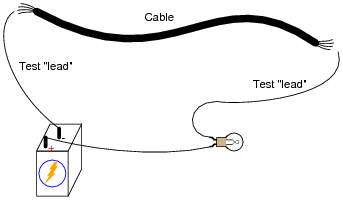
Notes:A significant portion of electrical/electronic circuit problems are caused by nothing more complex than broken wire connections, or faults along the length of wires. Testing cables for wire breaks is a very practical exercise.
The same technique may be used to “map” wires from one end of a cable to the other, in the event that the wires are not color-coded or otherwise made identifiable.

Related Tools:
- Performance-Based Assessments for Semiconductor Circuit Competencies
- Specific Resistance of Conductors