Facebook
 Google
 GitHub
 Linkedin
Basic Electricity
Basic Electricity Worksheet
38 questions By Tony R. Kuphaldt
-
Question 4 of 38
How might you use a meter (or a conductivity/continuity tester) to determine whether this electrical switch is in the open or closed state?

Reveal answerMost multimeters have a “resistance” measurement range (“Ohms scale”) that may be used to check continuity. Either using a meter or a conductivity/continuity tester, measure between the two screw terminals of this switch: if the resistance is low (good conductivity), then the switch is closed. If the measured resistance is infinite (no conductivity), then the switch is open.
Notes:This is another question which lends itself well to experimentation. A vitally important skill for students to develop is how to use their test equipment to diagnose the states of individual components.
An inexpensive source of simple (SPST) switches is a hardware store: use the same type of switch that is used in household light control. These switches are very inexpensive, rugged, and come with heavy-duty screw terminals for wire attachment. When used in small battery-powered projects, they are nearly indestructible!
-
Question 5 of 38
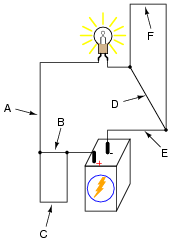
Determine if the light bulb will de-energize for each of the following breaks in the circuit. Consider just one break at a time:
- • Choose one option for each point:
- • A: de-energize / no effect
- • B: de-energize / no effect
- • C: de-energize / no effect
- • D: de-energize / no effect
- • E: de-energize / no effect
- • F: de-energize / no effect
Reveal answer- • A: de-energize
- • B: no effect
- • C: no effect
- • D: no effect
- • E: de-energize
- • F: no effect
Notes:This question is an important one in the students’ process of learning troubleshooting. Emphasize the importance of inductive thinking: deriving general principles from specific instances. What does the behavior of this circuit tell us about electrical continuity?
-
Question 6 of 38
Shown here is a simplified representation of an atom: the smallest division of matter that may be isolated through physical or chemical methods.

Inside of each atom are several smaller bits of matter called particles. Identify the three different types of “elementary” particles inside an atom, their electrical properties, and their respective locations within the atom.
Reveal answer
Neutrons reside in the center (“nucleus”) of the atom, as do protons. Neutrons are electrically neutral (no charge), while protons have a positive electrical charge. Electrons, which reside outside the nucleus, have negative electrical charges.
Notes:Most, if not all, students will be familiar with the “solar system” model of an atom, from primary and secondary science education. In reality, though, this model of atomic structure is not that accurate. As far as anyone knows, the actual physical layout of an atom is much, much weirder than this!
A question that might come up in discussion is the definition of “charge.” I’m not sure if it is possible to fundamentally define what “charge” is. Of course, we may discuss “positive” and “negative” charges in operational terms: that like charges repel and opposite charges attract. However, this does not really tell us what charge actually is. This philosophical quandary is common in science: to be able to describe what something is in terms of its behavior but not its identity or nature.

Related Tools:
- Performance-Based Assessments for Semiconductor Circuit Competencies
- Specific Resistance of Conductors