Facebook
 Google
 GitHub
 Linkedin
DC Electric Circuits
Capacitance
19 questions By Tony R. Kuphaldt
-
Question 13 of 19
Suppose a mass is connected to a winch by means of a cable, and a person turns the winch drum to raise the mass off the ground:
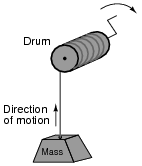
A physicist would likely look at this scenario as an example of energy exchange: the person turning the drum is expending energy, which in turn is being stored in the mass in potential form.
Suppose now that the person stops turning the drum and instead engages a brake mechanism on the drum so that it reverses rotation and slowly allows the mass to return to ground level. Once again, a physicist would view this scenario as an exchange of energy: the mass is now releasing energy, while the brake mechanism is converting that released energy into heat:
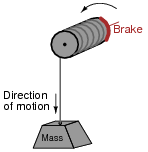
In each of the above scenarios, draw arrows depicting directions of two forces: the force that the mass exerts on the drum, and the force that the drum exerts on the mass. Compare these force directions with the direction of motion in each scenario, and explain how these directions relate to the mass and drum alternately acting as energy source and energy load.
Reveal answer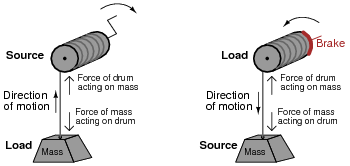
Follow-up question: although it may not be obvious, this question closely relates to the exchange of energy between components in electrical circuits! Explain this analogy.
Notes:Students typically find the concept of energy flow confusing with regard to electrical components. I try to make this concept clearer by using mechanical analogies, in which force and motion act as analog quantities to voltage and current (or visa-versa).
-
Question 14 of 19
Draw the direction of current in this circuit, and also identify the polarity of the voltage across the battery and across the resistor. Then, compare the battery’s polarity with the direction of current through it, and the resistor’s polarity with the direction of current through it.

What do you notice about the relationship between voltage polarity and current direction for these two different types of components? Identify the fundamental distinction between these two components that causes them to behave differently.
Reveal answerHere I show the answer in two different forms: current shown as electron flow (left) and current shown as conventional flow (right).
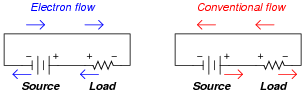
Whichever notation you choose to follow in your analysis of circuits, the understanding should be the same: the reason voltage polarities across the resistor and battery differ despite the same direction of current through both is the flow of power. The battery acts as a source, while the resistor acts as a load.
Notes:This type of distinction is very important in the study of physics as well, where one must determine whether a mechanical system is doing work or whether work is being done on it. A clear understanding of the relationship between voltage polarity and current direction for sources and loads is very important for students to have before they study reactive devices such as inductors and capacitors!
-
Question 15 of 19
Suppose a capacitor is connected directly to an adjustable-voltage source, and the voltage of that source is steadily increased over time. We know that an increasing voltage across a capacitor will produce an electric field of increasing strength. Does this increase in electric field constitute an accumulation of energy in the capacitor, or a release of energy from the capacitor? In this scenario, does the capacitor act as a load or as a source of electrical energy?
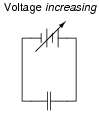
Now, suppose the adjustable voltage source is steadily decreased over time. We know this will result in an electric field of decreasing strength in the capacitor. Does this decrease in electric field constitute an accumulation of energy in the capacitor, or a release of energy from the capacitor? In this scenario, does the capacitor act as a load or as a source of electrical energy?
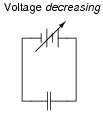
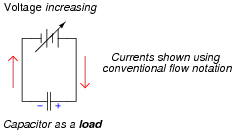
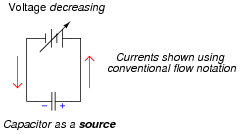
For each of these scenarios, label the direction of current in the circuit.
Reveal answerAs the applied voltage increases, the capacitor acts as a load, accumulating additional energy from the voltage source. Acting as a load, the current going “through” the capacitor will be in the same direction as through a resistor.
As the applied voltage decreases, the capacitor acts as a source, releasing accumulated energy to the rest of the circuit, as though it were a voltage source itself of superior voltage. Acting as a source, the current going “through” the capacitor will be in the same direction as through a battery, powering a load.
Notes:Relating the direction of current in a capacitor to a change of applied voltage over time is a complex concept for many students. Since it involves rates of change over time, it is an excellent opportunity to introduce calculus concepts d/dt.
Vitally important to students’ conceptual understanding of a capacitor exposed to increasing or decreasing voltages is the distinction between an electrical energy source versus a load. Students need to think “battery” and “resistor,” respectively when determining the relationship between direction of current and voltage drop. The complicated aspect of capacitors (and inductors!) is that they may switch character in an instant, from being a source of energy to being a load, and visa-versa. The relationship is not fixed as it is for resistors, which are always energy loads.