Facebook
 Google
 GitHub
 Linkedin
Analog Integrated Circuits
OpAmp Oscillator Circuits
16 questions By Tony R. Kuphaldt
-
Question 13 of 16
Identify at least two different component faults that would result in a change in duty cycle for this oscillator circuit:
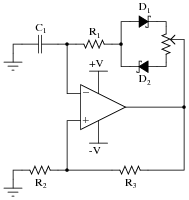
Reveal answerA short in either of the two diodes would cause the duty cycle to change.
Follow-up question: what would happen if either of these two diodes failed open?
Notes:Ask your students to explain why the duty cycle would change as a result of either diode failing shorted. This is a good opportunity to further explore the operation of this oscillator circuit.
-
Question 14 of 16
Suppose this LC oscillator stopped working, and you suspected either the capacitor or the inductor as having failed. How could you check these two components without the use of an LCR meter?
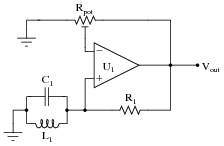
Reveal answerTry using an ohmmeter on each component, removed from the circuit. The capacitor should read “open” and the inductor should read a low resistance, if both are in good condition.
Follow-up question: is an ohmmeter test comprehensive enough to detect all possible faults with these two types of components? Why or why not? Be as specific as you can in your answer(s).
Notes:Knowing how to check the condition of components with primitive test equipment is a valuable skill. It is well worth your time to discuss this question (and its answers) with your students in detail, so they all understand the concepts involved.
-
Question 15 of 16
Most operational amplifiers do not have the ability to swing their output voltages rail-to-rail. Most of those do not swing their output voltages symmetrically. That is, a typical non-rail-to-rail opamp may be able to approach one power supply rail voltage closer than the other; e.g. when powered by a 15/-15 volt split supply, the output saturates positive at 14 volts and saturates negative at -13.5 volts.
What effect do you suppose this non-symmetrical output range will have on a typical relaxation oscillator circuit such as the following, and how might you suggest we fix the problem?
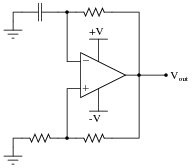
Reveal answerThe duty cycle will not be 50%. One way to fix the problem is to do something like this:

Follow-up question: explain how and why this solution works. Now you just knew I was going to ask this question the moment you saw the diagram, didn’t you?
Notes:Note that I added an additional resistor to the circuit, in series with the opamp output terminal. In some cases this is not necessary because the opamp is self-limiting in output current, but it is a good design practice nonetheless. In the event anyone ever swaps out the original opamp for a different model lacking overcurrent protection, the new opamp will not become damaged.