Facebook
 Google
 GitHub
 Linkedin
Analog Integrated Circuits
Active Filters
32 questions By Tony R. Kuphaldt
-
Question 22 of 32
Choose appropriate values for this Sallen-Key high-pass filter circuit to give it a cutoff frequency of 7 kHz with a “Butterworth” response:

f−3dB = √2 2 πR CA good guideline to follow is to make sure no component impedance (ZR or ZC) at the cutoff frequency is less than 1 kΩ or greater than 100 kΩ.
Reveal answerBear in mind that this is just one possible set of component values:
- C = 3.3 nF
- R = 9.744 kΩ
- R/2 = 4.872 kΩ
Follow-up question: how would you suggest we obtain the precise resistance values necessary to build this circuit?
Notes:In order for students to solve for R, they must algebraically manipulate the cutoff frequency formula. Ask them why we might choose a standard value for capacitance and then calculate a non-standard value for resistance. Why not the other way around (first choose R, then calculate C)?
-
Question 23 of 32
Choose appropriate values for this Sallen-Key low-pass filter circuit to give it a cutoff frequency of 4.2 kHz with a “Butterworth” response:
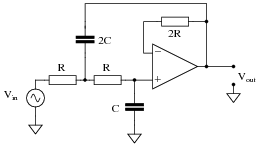
f−3dB = 1 2 √2 πR CA good guideline to follow is to make sure no component impedance (ZR or ZC) at the cutoff frequency is less than 1 kΩ or greater than 100 kΩ.
Reveal answerBear in mind that this is just one possible set of component values:
- C = 0.0047 μF
- 2C = 0.0094 μF
- R = 5.701 kΩ
- 2R = 11.402 kΩ
Follow-up question: while 0.0047 μF is a common capacitor size, 0.0094 μF is not. Explain how you could obtain this precise value of capacitance needed to build this circuit.
Notes:In order for students to solve for R, they must algebraically manipulate the cutoff frequency formula. Ask them why we might choose a standard value for capacitance and then calculate a non-standard value for resistance. Why not the other way around (first choose R, then calculate C)?
-
Question 24 of 32
A popular passive filtering network called the twin-tee is often coupled with an operational amplifier to produce an active filter circuit. Two examples are shown here:
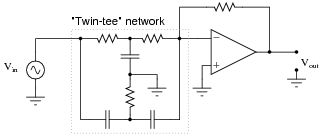
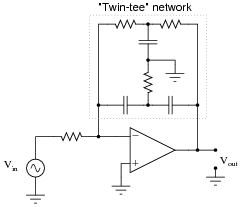
Identify which of these circuits is band-pass, and which is band-stop. Also, identify the type of response typically provided by the twin-tee network alone, and how that response is exploited to make two different types of active filter responses.
Reveal answerThe first filter shown is a band-stop, while the second filter shown is a band-pass.
Notes:Like all the other active filter circuits, the fundamental characteristic of each filter may be determined by qualitative analysis at f = 0 and f = ∞.
An interesting concept at work here is the inversion of a function by placement inside the feedback loop of a negative-feedback opamp circuit. What is a band-stop filter all by itself forces the opamp to be a band-pass if placed within the negative feedback signal path. Discuss this very important concept with your students, as this is most definitely not the only application for it!