
 Facebook
 Google
 GitHub
 Linkedin
DC Electric Circuits
Ammeter Design
13 questions By Tony R. Kuphaldt
-
Question 7 of 13
Ideally, should an ammeter have a very low input resistance, or a very high input resistance (input resistance being the amount of electrical resistance intrinsic to the meter, as measured between its test leads)? Explain your answer.
Reveal answerIdeally, an ammeter should have the least amount of input resistance possible. This is important when using it to measure current in circuits containing little resistance.
Notes:The answer to this question is related to the very important principle of meter loading. Technicians, especially, have to be very aware of meter loading, and how erroneous measurements may result from it. The answer is also related to how ammeters are connected with the circuits under test: always in series!
-
Question 8 of 13
For any given range of current measurement, what design parameter(s) of an electromechanical ammeter influence its input resistance? In other words, to approach the “ideal” input resistance of an ammeter, for any given range, what component values are optimum?
Reveal answerTo achieve the lowest possible input resistance, without changing the range of the ammeter, you need a meter movement with a minimum full-scale current rating and a minimum amount of coil resistance.
Challenge question: is it possible to improve the performance of an ammeter’s meter movement, as per the recommendations given here, by adding resistors to it? If so, how?
Notes:If your students have already studied voltmeter design, you might want to ask them to compare the (single) design factor influencing sensitivity (“ohms-per-volt”) in an electromechanical voltmeter with the two factors listed in the answer to this question. Why is the meter movement coil resistance not a factor in voltmeter sensitivity, but it is in ammeter sensitivity? Challenge your students with this question, by having them propose some example voltmeter circuits and ammeter circuits with different coil resistances. Let them figure out how to set up the problems, rather than you setting up the problems for them!
Some students may suggest that the effective coil resistance of a meter movement may be decreased with the addition of a shunt resistance inside the movement. If anyone proposes this solution, work through the calculations of an example ammeter circuit on the whiteboard with the class and see what the effect is!
-
Question 9 of 13
Shunt resistors are often used as current-measuring devices, in that they are designed to drop very precise amounts of voltage as large electric currents pass through them. By measuring the amount of voltage dropped by a shunt resistor, you will be able to determine the amount of current going through it:
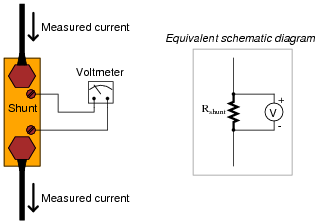
Suppose that a shunt resistance is labeled with the following rating: 150 A , 50 mV. What is the resistance of this shunt, in ohms? Express your answer in metric notation, scientific notation, and plain decimal notation.
Reveal answerMetric notation: 333.3 μΩ
Scientific notation: 3.333 ×10⁻⁴ Ω
Plain decimal notation: 0.0003333 Ω
Notes:Ask your students how they think a resistor could be made with such a low resistance (a tiny fraction of an ohm!). What do they think a shunt resistor would look like in real life? If you happen to have a shunt resistor available in your classroom, show it to your students after they express their opinions on its construction.





Hi, Another solution for question 2 could be a parallel connection of the Anmeter with a serial resistor of 6000-400= 5600ohms in parallel with the 6 ohms resistor. Is that correct ?
have answr to immediate follow questions…...........prevent scrolloing.