Facebook
 Google
 GitHub
 Linkedin
Analog Integrated Circuits
Basic Operational Amplifiers
18 questions By Tony R. Kuphaldt
-
Question 10 of 18
Predict how the operation of this operational amplifier circuit will be affected as a result of the following faults. Specifically, identify whether the output voltage (Vout) will move in a positive direction (closer to the V rail) or in a negative direction (closer to ground). Consider each fault independently (i.e. one at a time, no multiple faults):
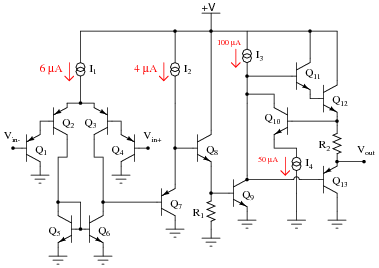
- Transistor Q5 fails shorted (collector-to-emitter):
- Transistor Q6 fails shorted (collector-to-emitter):
- Resistor R1 fails open:
- Current source I2 fails shorted:
For each of these conditions, explain why the resulting effects will occur.
Reveal answer- Transistor Q5 fails shorted (collector-to-emitter): Vout goes negative.
- Transistor Q6 fails shorted (collector-to-emitter): Vout goes positive.
- Resistor R1 fails open: Vout goes negative.
- Current source I2 fails shorted: Vout goes negative.
Notes:The purpose of this question is to approach the domain of circuit troubleshooting from a perspective of knowing what the fault is, rather than only knowing what the symptoms are. Although this is not necessarily a realistic perspective, it helps students build the foundational knowledge necessary to diagnose a faulted circuit from empirical data. Questions such as this should be followed (eventually) by other questions asking students to identify likely faults based on measurements.
-
Question 11 of 18
Predict how the operation of this operational amplifier circuit will be affected as a result of the following faults. Specifically, identify whether the output voltage (Vout) will move in a positive direction (closer to the V rail) or in a negative direction (closer to the -V rail). Consider each fault independently (i.e. one at a time, no multiple faults):

- Diode D1 fails open:
- Resistor R1 fails shorted:
- Transistor Q2 fails shorted (drain-to-source):
- Transistor Q5 fails shorted (collector-to-emitter):
- Resistor R2 fails open:
- Current source I2 fails open:
For each of these conditions, explain why the resulting effects will occur.
Reveal answer- Diode D1 fails open: Vout goes positive.
- Resistor R1 fails shorted: Vout goes negative.
- Transistor Q2 fails shorted (drain-to-source): Vout goes negative.
- Transistor Q5 fails shorted (collector-to-emitter): Vout goes positive.
- Resistor R2 fails open: Vout goes negative.
- Current source I2 fails open: Vout goes negative.
Notes:The purpose of this question is to approach the domain of circuit troubleshooting from a perspective of knowing what the fault is, rather than only knowing what the symptoms are. Although this is not necessarily a realistic perspective, it helps students build the foundational knowledge necessary to diagnose a faulted circuit from empirical data. Questions such as this should be followed (eventually) by other questions asking students to identify likely faults based on measurements.
-
Question 12 of 18
Ideally, what should the output voltage of an op-amp do if the non-inverting voltage is greater (more positive) than the inverting voltage?

Reveal answerIn this condition, the output of the op-amp should saturate positive ( V), as if a direct connection were made inside the op-amp between the output terminal and the V power supply terminal:
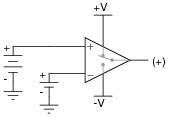
Notes:Determining which “way” the output of an op-amp drives under different input voltage conditions is confusing to many students. Discuss this with them, and ask them to present any principles or analogies they use to remember “which way is which.”