Facebook
 Google
 GitHub
 Linkedin
DC Electric Circuits
DC Generator Theory
14 questions By Tony R. Kuphaldt
-
Question 10 of 14
A shunt-wound generator has an electromagnet “field” winding providing the stationary magnetic field in which the armature rotates:

Like all electromagnets, the magnetic field strength produced is in direct proportion to the amount of current through the wire coil. But when the generator is sitting still, its output voltage is zero, and therefore there will be no current through the field winding to energize it and produce a magnetic field for the armature to rotate through. This causes a problem, since the armature will not have any voltage induced in its windings until it is rotating and it has a stationary magnetic field from the field winding to rotate through.
It seems like we have a catch-22 situation here: the generator cannot output a voltage until its field winding is energized, but its field winding will not be energized until the generator (armature) outputs some voltage. How can this generator ever begin to output voltage, given this predicament?
Reveal answerUsually, there is enough residual magnetism left in the field poles to initiate some generator action when turned.
Challenge question: what we could do if the generator’s field poles ever totally lost their residual magnetism? How could the generator ever be started?
Notes:Back in the days when generators were common in automotive electrical systems, this used to be a fairly common problem. However, generators could be “flashed” so as to re-establish this residual magnetic field once again.
-
Question 11 of 14
In a shunt-wound DC generator, the output voltage is determined by the rotational speed of the armature and the density of the stationary magnetic field flux. For a given armature speed, what prevents the output voltage from “running away” to infinite levels, since the output voltage energizes the field winding, which leads to greater field flux, which leads to greater output voltage, which leads to greater field flux, which leads to . . . ?

Obviously, there must be some inherent limit to this otherwise vicious cycle. Otherwise, the output voltage of a shunt-wound DC generator would be completely unstable.
Reveal answerAt a certain amount of field winding current, the generator’s field poles saturate, preventing further increases in magnetic flux.
Notes:This question provides a great opportunity to review the concept of magnetic “saturation,” as well as introduce the engineering concept of positive feedback.
-
Question 12 of 14
With regard to a DC electric generator, what is the neutral plane? Why is this important?
Reveal answerThe “neutral plane” is that point of rotation where a rotating armature winding has no induced voltage in it, due to [(dφ)/dt] being equal to zero. In a simple, two-pole machine, the neutral plane is perpendicular to the centerline of the field poles:
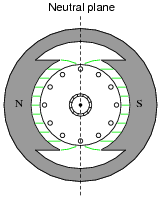
Notes:Ask your students why the “neutral plane” is an important aspect of a DC generator or motor’s geometry. What relation does the neutral plane have with regard to brush positioning? At what point in the armature’s rotation do we want to have the brushes break contact with one commutator bar and make contact with another: when the coil primary to that commutator segment is outputting maximum voltage, or minimum voltage?