
 Facebook
 Google
 GitHub
 Linkedin
DC Electric Circuits
DC Generator Theory
14 questions By Tony R. Kuphaldt
-
Question 4 of 14
If this wire (between the magnet poles) is moved in an upward direction, what polarity of voltage will the meter indicate?
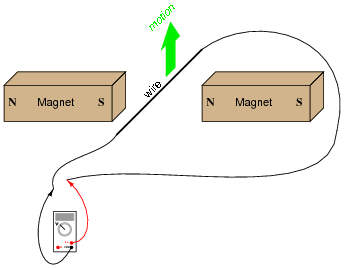
Describe the factors influencing the magnitude of the voltage induced by motion, and determine whether this is an example of an electric motor or an electric generator.
Reveal answerThe voltmeter will indicate a negative voltage in this generator example.
Notes:Ask your students to explain their answers regarding factors that influence voltage magnitude. Where did they obtain their information? Are there any mathematical formulae relating these factors to induced voltage?
-
Question 5 of 14
If this wire (between the magnet poles) is moved in an upward direction, and the wire ends are connected to a resistive load, which way will current go through the wire?
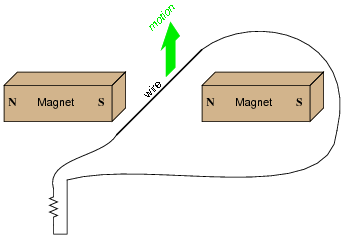
We know that current moving through a wire will create a magnetic field, and that this magnetic field will produce a reaction force against the static magnetic fields coming from the two permanent magnets. Which direction will this reaction force push the current-carrying wire? How does the direction of this force relate to the direction of the wire’s motion? Does this phenomenon relate to any principle of electromagnetism you’ve learned so far?
Reveal answerThe reaction force will be directly opposed to the direction of motion, as described by Lenz’s Law.
Follow-up question: What does this phenomenon indicate to us about the ease of moving a generator mechanism under load, versus unloaded? What effect does placing an electrical load on the output terminals of a generator have on the mechanical effort needed to turn the generator?
Notes:If you happen to have a large, permanent magnet DC motor available in your classroom, you may easily demonstrate this principle for your students. Just have them spin the shaft of the motor (generator) with their hands, with the power terminals open versus shorted together. Your students will notice a huge difference in the ease of turning between these two states.
After your students have had the opportunity to discuss this phenomenon and/or experience it themselves, ask them why electromechanical meter movement manufacturers usually ship meters with a shorting wire connecting the two meter terminals together. In what way does a PMMC meter movement resemble an electric generator? How does shorting the terminals together help to protect against damage from physical vibration during shipping?
Ask your students to describe what factors influence the magnitude of this reaction force.
-
Question 6 of 14
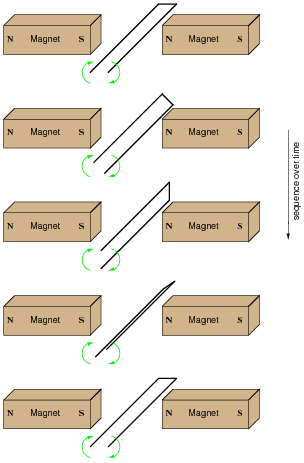
Determine the polarity of induced voltage between the ends of this wire loop, as it is rotated between the two magnets:
Reveal answer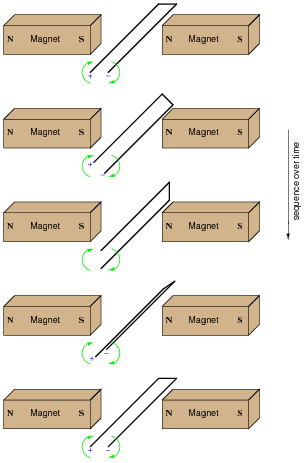
Challenge question: if a resistor were connected between the ends of this wire loop, would it be direct current (DC), or alternating current (AC)?
Notes:Note that the two wire ends switch polarity as the loop rotates. Ask your students to explain why the polarities are as they are.


