Facebook
 Google
 GitHub
 Linkedin
DC Electric Circuits
DC Generator Theory
14 questions By Tony R. Kuphaldt
-
Question 7 of 14
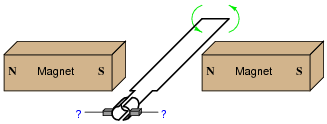
If the ends of a wire loop are attached to two half-circular metal strips, arranged so that the two strips almost form a complete circle, and those strips are contacted by two “brushes” which connect to opposite poles of a battery, what polarity of voltage will be measured as the loop is rotated counter-clockwise?
Reveal answer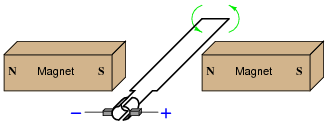
Follow-up question: does the polarity measured at the two carbon brushes ever reverse? Or, to phrase the question another way, if a resistor were connected between the two brush contacts, would it “see” direct current (DC) or alternating current (AC)? Explain your answer.
Notes:Ask your students what the two half-circle metal strips are called, in electric motor/generator terminology.
-
Question 8 of 14
How does Faraday’s Law of electromagnetic induction relate to the voltage output of a DC generator? According to Faraday’s Law, what factors can we alter to increase the voltage output by a DC generator?
Reveal answerIncrease the \(\frac{dφ}{dt}\) rate of change, or increase the number of turns in the armature winding.
Notes:Ask your students to write the equation for Faraday’s Law on the whiteboard, and then analyze it in a qualitative sense (with variables increasing or decreasing in value) to validate the answers.
The first answer to this question (increase \(\frac{dφ}{dt}\) has been left purposefully vague, in order to make students think. What, specifically, must be changed in order to increase this rate-of-change over time? Which real-world variables are changeable after the generator has been manufactured, and which are not?
-
Question 9 of 14
DC generators will act as DC motors if connected to a DC power source and not spun at a sufficient speed. This is a problem in DC power systems, as the generator will act as a load, drawing energy from the battery, when the engine or other “prime mover” device stops moving. This simple generator/battery circuit, for example, would not be practical for this reason:

Back in the days when automobiles used DC generators to charge their batteries, a special relay called the reverse current cutout relay was necessary to prevent battery discharge through the generator whenever the engine was shut off:

When the generator is spun fast enough, it generates enough voltage to energize the shunt coil with enough current to close the relay contact. This connects the generator with the battery, and charging current flows through the series coil, creating even more magnetic attraction to hold the relay contact closed. If the battery reaches a full charge and does not draw any more charging current from the generator, the relay will still remain closed because the shunt coil is still energized.
However, the relay contact will open if the generator ever begins to act as a load to the battery, drawing any current from it. Explain why this happens.
Reveal answerIf a reverse current goes through the series coil, the magnetic field produced will “buck” the magnetic field produced by the shunt coil, thus weakening the total magnetic field strength pulling at the armature of the relay.
Notes:A “reverse current cutout” relay ingeniously exploits reversible magnetic polarities to close or open a contact under the proper conditions. Although DC generators are no longer used in the majority of automobile electrical systems (AC alternators using bridge rectifiers to convert AC to DC are used instead, with the rectifier circuit naturally preventing reverse current), this application provides an excellent opportunity to explore an application of relay technology in the context of generator control.