
 Facebook
 Google
 GitHub
 Linkedin
DC Electric Circuits
Inductance
20 questions By Tony R. Kuphaldt
-
Question 13 of 20
∫f(x) dx Calculus alert!
Ohm’s Law tells us that the amount of voltage dropped by a fixed resistance may be calculated as such:E = IR However, the relationship between voltage and current for a fixed inductance is quite different. The “Ohm’s Law” formula for an inductor is as such:
e = L di dtWhat significance is there in the use of lower-case variables for current (i) and voltage (e)? Also, what does the expression [di/dt] mean? Note: in case you think that the d’s are variables, and should cancel out in this fraction, think again: this is no ordinary quotient! The d letters represent a calculus concept known as a differential, and a quotient of two d terms is called a derivative.
Reveal answerLower-case variables represent instantaneous values, as opposed to average values. The expression \(\frac{di}{dt}\) represents the instantaneous rate of change of current over time.
Follow-up question: manipulate this equation to solve for the other two variables (\(\frac{di}{dt}\) = … ; L = …).
Notes:I have found that the topics of capacitance and inductance are excellent contexts in which to introduce fundamental principles of calculus to students. The time you spend discussing this question and questions like it will vary according to your students’ mathematical abilities.
Even if your students are not ready to explore calculus, it is still a good idea to discuss how the relationship between current and voltage for an inductance involves time. This is a radical departure from the time-independent nature of resistors, and of Ohm’s Law!
-
Question 14 of 20
Complete this statement by substituting the correct electrical variables (voltage, current, resistance, inductance):
- Inductors oppose changes in (fill-in-the-blank), reacting to such changes by producing a (fill-in-the-blank).
Reveal answerInductors oppose changes in current, reacting to such changes by producing a voltage.
Notes:Emphasize to your students that inductance is an essentially reactive property, opposing change in current over time. It is not steady current that inductors react to, only changing current.
-
Question 15 of 20
Many years ago, I decided to experiment with electromagnetism by making an electromagnet out of a spool of wire. I placed a steel bolt through the center of the spool so as to have a core of high permeability, and passed current from a battery through the wire to make a magnetic field. Not having any “jumper” wires, I held the wire ends of the spool in contact with the 9-volt battery terminals, one in each hand.
The electromagnet worked just fine, and I was able to move some steel paperclips with the magnetic field generated by it. However, when I broke the circuit by releasing one of the wire ends from the battery terminal it was touching, I received a small electric shock! Shown here is a schematic diagram of me, in the circuit:
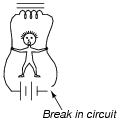
At the time, I didn’t understand how inductance worked. I only understood how to make magnetism with electricity, but I didn’t realize a coil of wire could generate (high voltage!) electricity from its own magnetic field. I did know, however, that the 9 volts output by the battery was much too weak to shock me (yes, I touched the battery terminals directly to verify this fact), so something in the circuit must have generated a voltage greater than 9 volts.
If you had been there to explain what just happened to me, what would you say?
Reveal answerThere are a couple of different ways to explain how an electromagnet coil can generate a much greater voltage than what it is energized from (the battery). One way is to explain the origin of the high voltage using Faraday’s Law of electromagnetic induction (e = N\(\frac{dφ}{dt}\), or e = L\(\frac{di}{dt}\)). Another way is to explain how it is the nature of an inductor to oppose any change in current over time. I’ll leave it to you to figure out the exact words to say!
Notes:One way to help understand how an inductor could produce such large voltages is to consider it as a temporary current source, which will output as much voltage as necessary in an effort to maintain constant current. Just as ideal current sources are dangerous to open-circuit, current-carrying inductors are likewise capable of generating tremendous transient voltages.
Although there was no real safety hazard with my experiment, there potentially could have been, provided different circumstances. Discuss with your students what would have been necessary to create an actual safety hazard.


