Facebook
 Google
 GitHub
 Linkedin
Discrete Semiconductor Devices and Circuits
Miscellaneous Diode Applications
6 questions By Tony R. Kuphaldt
-
Question 4 of 6
What will an ammeter (with an input resistance of 0.5 Ω) register when connected in parallel with the diode in this circuit?
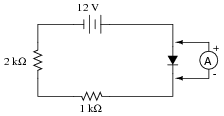
Usually, ammeters are connected in series with the component whose current is to be measured. However, in this case a parallel connection is acceptable. Explain why, and determine the ammeter’s current reading in this circuit.
Reveal answerThe ammeter will register a current of 4 mA.
Notes:A very important point to ask your students is how they figured out the meter’s indication. What circuit analysis technique did they use, and why?
Emphasize solving this problem without using a calculator to do the math. Are your students able to determine the result by estimation alone? Does the input resistance factor into the calculation significantly?
-
Question 5 of 6
Suppose a very important piece of electronic equipment (nuclear reactor shutdown controls, for instance) needed to be supplied with uninterruptible DC power. For reliability’s sake, this circuit gets its power from three (redundant) DC voltage sources:
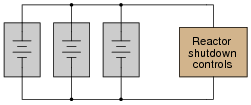
The only problem with this scenario is the possibility of one of these power sources internally short-circuiting. Describe what would happen if one of the three DC power sources developed an internal short-circuit, and explain how this problem could be avoided by placing diodes in the circuit.
Reveal answer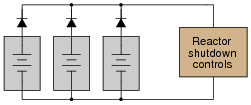
Challenge question: it would be nice if there were indicator lamps in the system to warn maintenance personnel of a shorted power supply. Is there any way you can think of to place light bulbs in this system somewhere, so that one will light up in the event of a power supply failure?
Notes:Discuss both the nature of the problem, and of the solution, with your students. Why does the proposed solution work to eliminate power failure in the event of a short-circuit internal to one of the power sources?
-
Question 6 of 6
Using a commutating diode (sometimes called a free-wheeling diode) to eliminate switch contact arcing for inductive loads in a DC circuit works well, but it has an unfortunate side-effect:
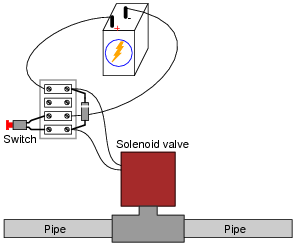
With a diode in place, the release time for the solenoid increases measurably. In other words, it takes longer for the solenoid to completely de-magnetize after the switch contacts open, than if there is no diode in the circuit.
Explain why this is, and also propose a solution for the minimizing the solenoid’s release time.
Reveal answerThe presence of a commutating diode increases the solenoid’s release time because the L/R time constant of the de-energizing circuit is made much longer than with no diode in place. The solution to this problem is to decrease the L/R time constant of the discharge circuit (I’ll let you figure out how!).
Notes:This question is an good review of inductor time constant theory, and challenges students to put their mastery of L/R time constant circuits to the test by engineering a solution for this problem.
Once a solution has been agreed upon, ask your students if the solution introduces (or re-introduces, as the case may be) any other problems in the circuit.