Facebook
 Google
 GitHub
 Linkedin
Analog Circuit Devices
Let’s assume your IC design needs an operational amplifier. Which one? As Figure 2-1 illustrates, you'll find hundreds of them if you check the data-books or websites of linear IC suppliers.
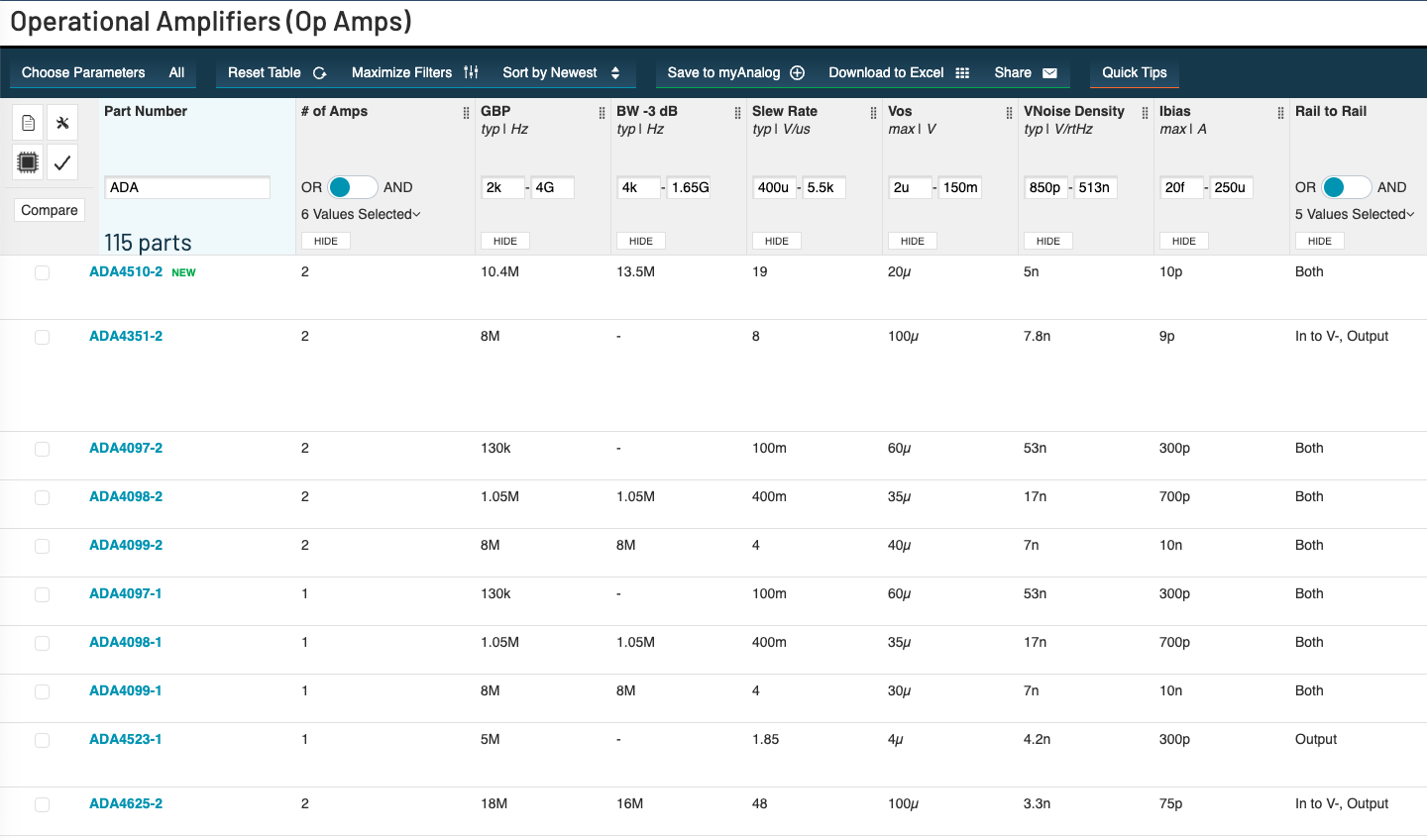
Figure 2-1. Example portion of an operational amplifier selection guide. Image used courtesy of Analog Devices
Some of the op amps have low current consumption but are slow. Others are quite complex but feature rail-to-rail inputs and outputs. There are:
- Inputs that are factory-trimmed for low offset voltages.
- Outputs for high currents.
- Designs for a single supply voltage.
- Very fast devices.
- …And more.
Here’s the inherent problem with analog building blocks: there are no ideal designs, just configurations that can be optimized for a particular application. If you envisioned a library from which you can pull various analog building blocks and insert them into your design, you’re about to experience a rude shock—this library would have to be very large, containing just about every operational amplifier (and all other linear functions) listed in the various data-books. If it didn't, your IC design would end up being inferior to one done with individual ICs.
In short, there are no standard analog cells. If your application is the least bit demanding, you’ll find yourself either modifying previously used blocks or designing new ones. In either case, you need to work on the device level, connecting together transistors, resistors, and rather small capacitors.
To do this, you need to know what devices are available and their limitations—but above all, you need a detailed understanding of the devices. The easiest way to learn about complex technical things is to follow their discovery, so that the knowledge gained by the earlier men and women who pioneered the field unfolds in the same way they brought it to light.