Facebook
 Google
 GitHub
 Linkedin
Capacitors in IC Processes
In semiconductor processes, the oxides providing isolation between layers are designed to give minimum stray capacitance. These oxides separate the metal interconnect from the silicon and different metal interconnect layers from each other. Even a small capacitor (say, 5 pF) would take up an enormous amount of space—enormous, at least, in microelectronic dimensions.
For that reason, fabricators often provide an additional mask step to outline an area where the oxide or nitride is thinned down considerably, producing a higher capacitance—about 2 fF/μm2, or 10–15 F/μm2 when converted from femtofarads. With this figure, which, of course, varies from process to process, a 50 × 50 μm capacitor gives you all of 5 pF. This can easily be the most expensive component in your chip. If you specify anything greater than 100 pF, your colleagues may think you have a degree in macroeconomics.
One plate of the capacitor is always either metal or poly. You can use a diffusion for the second plate, but doing so creates a slight voltage dependence. There’s always a depletion layer in silicon that widens as the voltage increases, adding to the distance between the plates. Poly or metal are better choices for the second plate.
The oxide underneath a MOS gate is already thinned down to achieve a reasonable transconductance, so it, too, has a higher capacitance per unit area than the ordinary field oxide. Be careful here, though—at zero DC voltage, there’s no channel. The source and drain form the lower plate, and the gate forms the upper one, so the only capacitance is the one from the gate to the overlapping parts of the drain and source.
When the voltage exceeds the threshold, the channel comes into existence and the capacitance increases markedly. Figure 2-33 shows the behavior of a large (10 × 20 μm), 3 V, NMOS device.
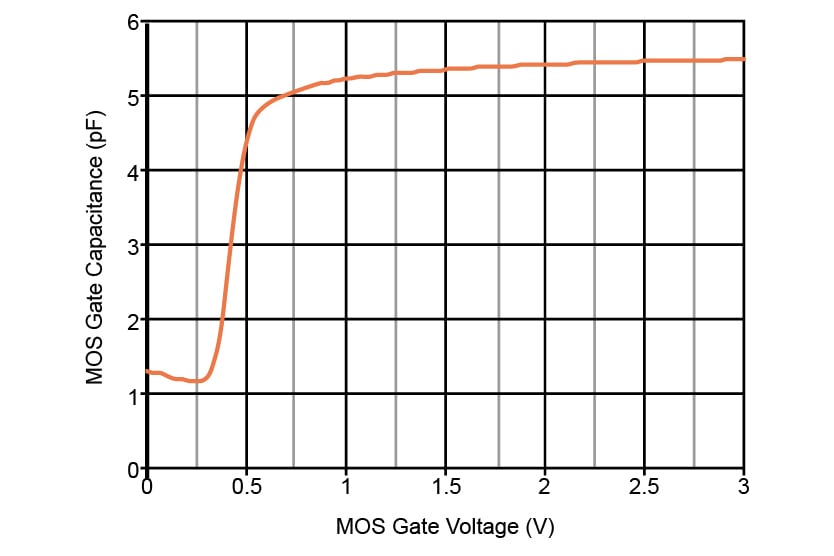
Figure 2-33. The gate capacitance of an MOS transistor is greatly dependent on voltage.
There’s also junction capacitance, which you shouldn’t dismiss lightly. The capacitance of a collector-base junction per unit area competes quite well with that of an oxide capacitor. It is, however, voltage-dependent, though not as much as the MOS gate capacitance. The stray capacitance for one plate, from collector to substrate, is also higher.
An even higher capacitance per unit area is offered by the base-emitter junction, though its breakdown is limited to about 6 V. The advantage of the junction capacitor is the elimination of the additional mask step.