
 Facebook
 Google
 GitHub
 Linkedin
Digital Circuits
Boolean Algebra
67 questions By Tony R. Kuphaldt
-
Question 49 of 67
Write the Boolean expression for this relay logic circuit, then reduce that expression to its simplest form using any applicable Boolean laws and theorems. Finally, draw a new relay circuit based on the simplified Boolean expression that performs the exact same logic function.

Reveal answerOriginal Boolean expression: \(\overline{\overline{AB}+C}\)
Reduced circuit (no relays needed!):

Notes:Ask your students to explain what advantages there may be to using the simplified relay circuit rather than the original (more complex) relay circuit shown in the question. What significance does this lend to learning Boolean algebra?
This is what Boolean algebra is really for: reducing the complexity of logic circuits. It is far too easy for students to lose sight of this fact, learning all the abstract rules and laws of Boolean algebra. Remember, in teaching Boolean algebra, you are supposed to be preparing students to perform manipulations of electronic circuits, not just equations.
-
Question 50 of 67
Write the Boolean expression for this TTL logic gate circuit, then reduce that expression to its simplest form using any applicable Boolean laws and theorems. Finally, draw a new gate circuit diagram based on the simplified Boolean expression, that performs the exact same logic function.
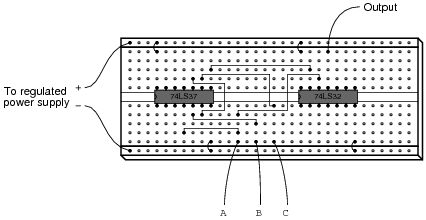
Reveal answerOriginal Boolean expression: \(A+\overline{\overline{AB}C}\)
Reduced gate circuit:

Challenge question: implement this reduced circuit, using the only remaining gates between the two integrated circuits shown on the original breadboard.
Notes:Ask your students to explain what advantages there may be to using the simplified gate circuit rather than the original (more complex) gate circuit shown in the question. What significance does this lend to learning Boolean algebra?
This is what Boolean algebra is really for: reducing the complexity of logic circuits. It is far too easy for students to lose sight of this fact, learning all the abstract rules and laws of Boolean algebra. Remember, in teaching Boolean algebra, you are supposed to be preparing students to perform manipulations of electronic circuits, not just equations.
-
Question 51 of 67
A student makes a mistake somewhere in the process of simplifying the Boolean expression \(\overline{\overline{X}Y+Z}\). Determine what the mistake is:
$$\overline{\overline{X}Y+Z}$$
$$\overline{\overline{X}Y}\overline{Z}$$
$$\overline{\overline{X}}+\overline{Y} \ \overline{Z}$$
$$X+\overline{Y} \ \overline{Z}$$
Reveal answerThe correct answer is:
$$(X+\overline{Y})\overline{Z}$$
$$or$$
$$X\overline{Z} + \overline{Y} \ \overline{Z}$$
If it is not apparent to you why the student’s steps are in error, try this exercise: draw the equivalent gate circuit for each of the expressions written in the student’s work. At the mistaken step, a dramatic change in the circuit configuration will be evident - a change that clearly cannot be correct. If all steps are proper, though, changes exhibited in the equivalent gate circuits should all make sense, culminating in a final (simplified) circuit.
Notes:An important aspect of long “bars” for students to recognize is that they function as grouping symbols. When applying DeMorgan’s Theorem to breaking these bars, students often make the mistake of ignoring the grouping implicit in the original bars.
I highly recommend you take your class through the exercise suggested in the answer, for those who do not understand the nature of the mistake. Let students draw each expression’s equivalent circuit on the board in front of the class so everyone can see, and then let them observe the dramatic change spoken of at the place where the mistake is made. If students understand what DeMorgan’s Theorem means for an individual gate (Neg-AND to NOR, Neg-OR to NAND, etc.), the gate diagrams will clearly reveal to them that something has gone wrong at that step.
For comparison, perform the same step-by-step translation of the proper Boolean simplification into gate diagrams. The transitions between diagrams will make far more sense, and students should be able to get a “circuit’s view” of why complementation bars function as grouping symbols.






Question 29, answer 3 has a typo - should be A*B + !(D)*E not A*B+!(D*E)